Why Many Children Struggle with Math in Primary 3: Understanding Scaffolding
Discover how scaffolding and the CPA approach help children build strong math concepts and overcome common Primary 3 learning challenges.
What Is Scaffolding in Mathematics Learning?
Have you ever wondered why your child seemed comfortable with Math in Primary 1 and Primary 2, but suddenly finds Primary 3 much more difficult?
One reason could be the lack of scaffolding.
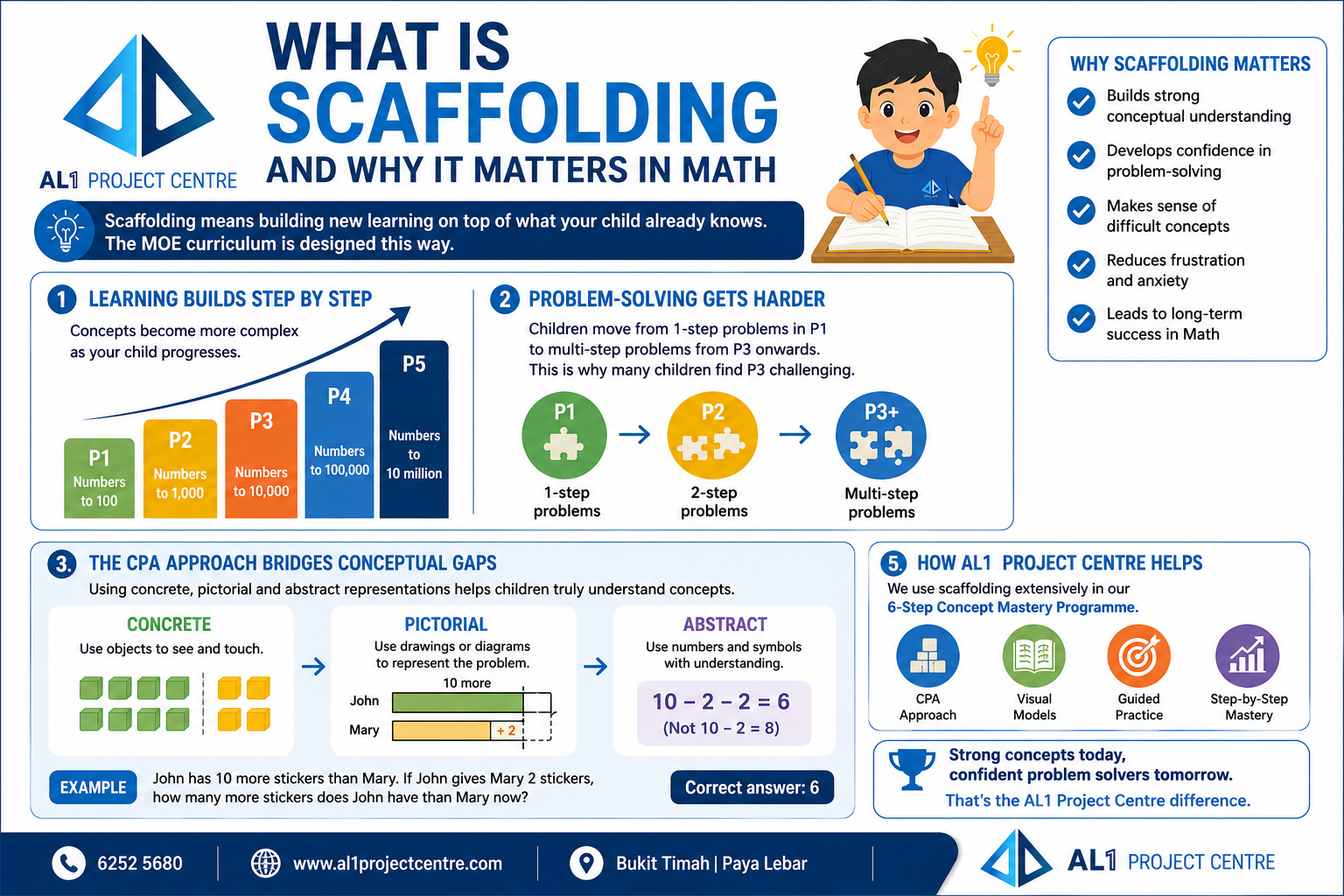
Scaffolding is the process of building new learning on top of existing knowledge. In fact, the MOE curriculum is designed this way. For example, children learn Whole Numbers progressively:
* P1: Numbers to 100
* P2: Numbers to 1,000
* P3: Numbers to 10,000
* P4: Numbers to 100,000
* P5: Numbers to 10 million
The same happens with problem-solving. Children move from 1-step word problems in P1 to multi-step problems from P3 onwards. This is why many children find the transition to P3 challenging.
When Practice Is Not the Answer
When children struggle, many parents buy more assessment books or enrol them in tuition.
However, the real issue is often not a lack of practice, but a conceptual gap.
As children progress through primary school, Math becomes increasingly abstract. Some children are not ready for this transition and begin to lose confidence.
How the CPA Approach Helps
One effective way to bridge conceptual gaps is the CPA Approach:
Concrete → Pictorial → Abstract
For example:
John has 10 more stickers than Mary. If John gives Mary 2 stickers, how many more stickers does John have than Mary now?
Many children answer 8, but the correct answer is 6 because John loses 2 stickers while Mary gains 2 stickers.
When children use counters, cubes, or simple drawings, they can see why the difference decreases by 4. This deeper understanding is often missing when they rely only on formulas.
How AL1 Project Centre Helps
At AL1 Project Centre, we use scaffolding extensively through our 6-Step Concept Mastery Programme. By combining the CPA approach, visual models, and guided practice, we help children build strong foundations before tackling challenging word problems.
Because when concepts are strong, problem-solving becomes much easier.