Is Drawing Models Compulsory for Solving Word Problems?
How should we respond when a child says there is no need to draw models?
Is Drawing Models Compulsory for Solving Word Problems?
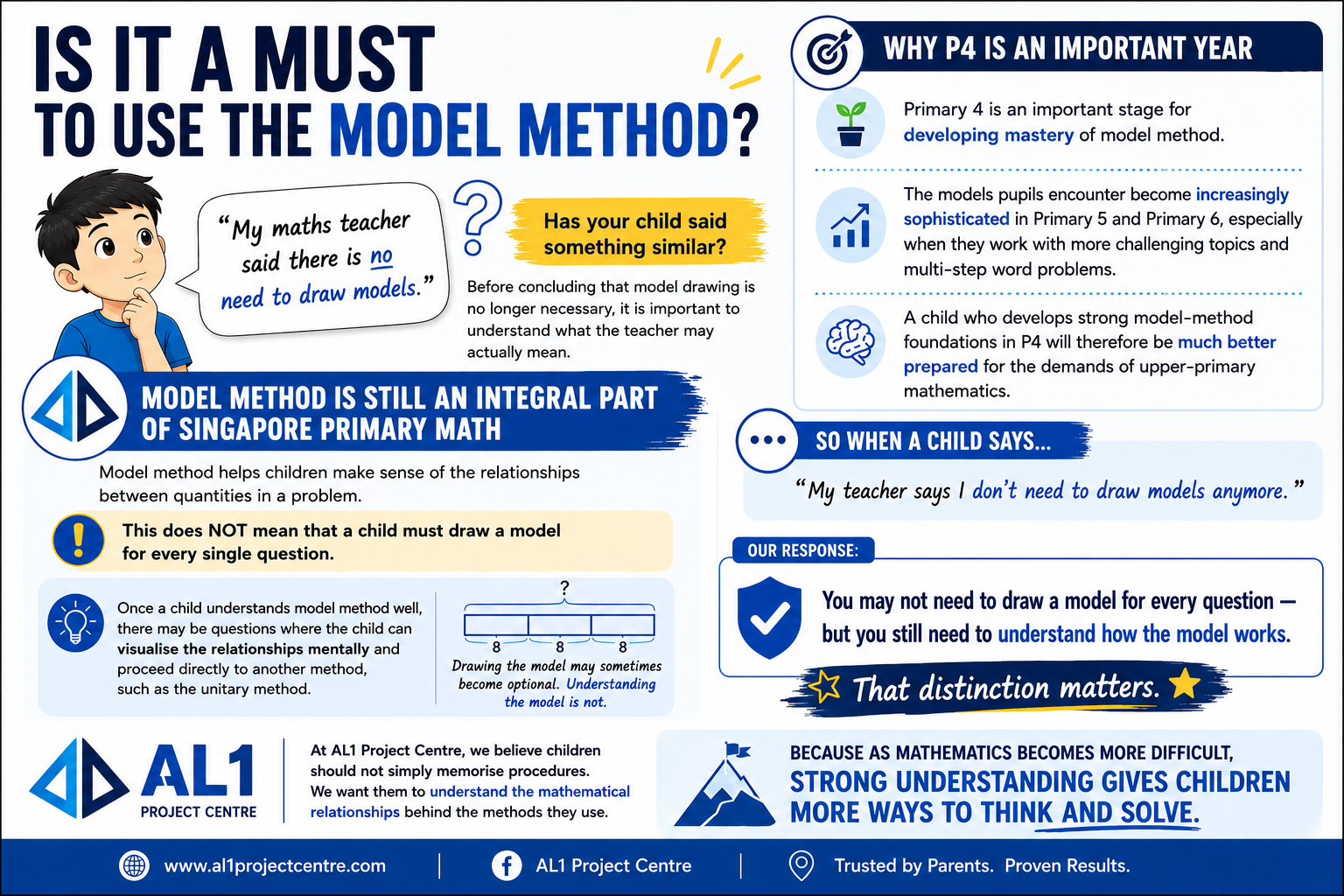
Recently, a Primary 4 boy told us:
“My maths teacher said there is no need to draw models.”
Has your child ever said something similar?
Before concluding that model drawing is no longer necessary, it is important to understand what the teacher may actually mean.
Model Method Is Still an Important Part of Primary Mathematics
The model method is an integral part of Singapore primary mathematics. More importantly, it helps children make sense of the relationships between quantities in a problem.
However, this does not mean that a child must draw a model for every single question.
Once a child understands model method well, there may be questions where the child can visualise the relationships mentally and proceed directly to another method, such as the unitary method.
In other words:
Drawing the model may sometimes become optional. Understanding the model is not.
Why P4 Is an Important Year
Primary 4 is an important stage for developing mastery of model method.
The models pupils encounter become increasingly sophisticated in Primary 5 and Primary 6, especially when they work with more challenging topics and multi-step word problems.
A child who develops strong model-method foundations in P4 will therefore be much better prepared for the demands of upper-primary mathematics.
So when a child says:
“My teacher says I don't need to draw models anymore,”
our response would be:
“You may not need to draw a model for every question — but you still need to understand how the model works.”
That distinction matters.
At AL1 Project Centre, we believe children should not simply memorise procedures. We want them to understand the mathematical relationships behind the methods they use.
Because as mathematics becomes more difficult, strong understanding gives children more ways to think and solve.