Lessons from PSLE 2026: Have a Clear Objective
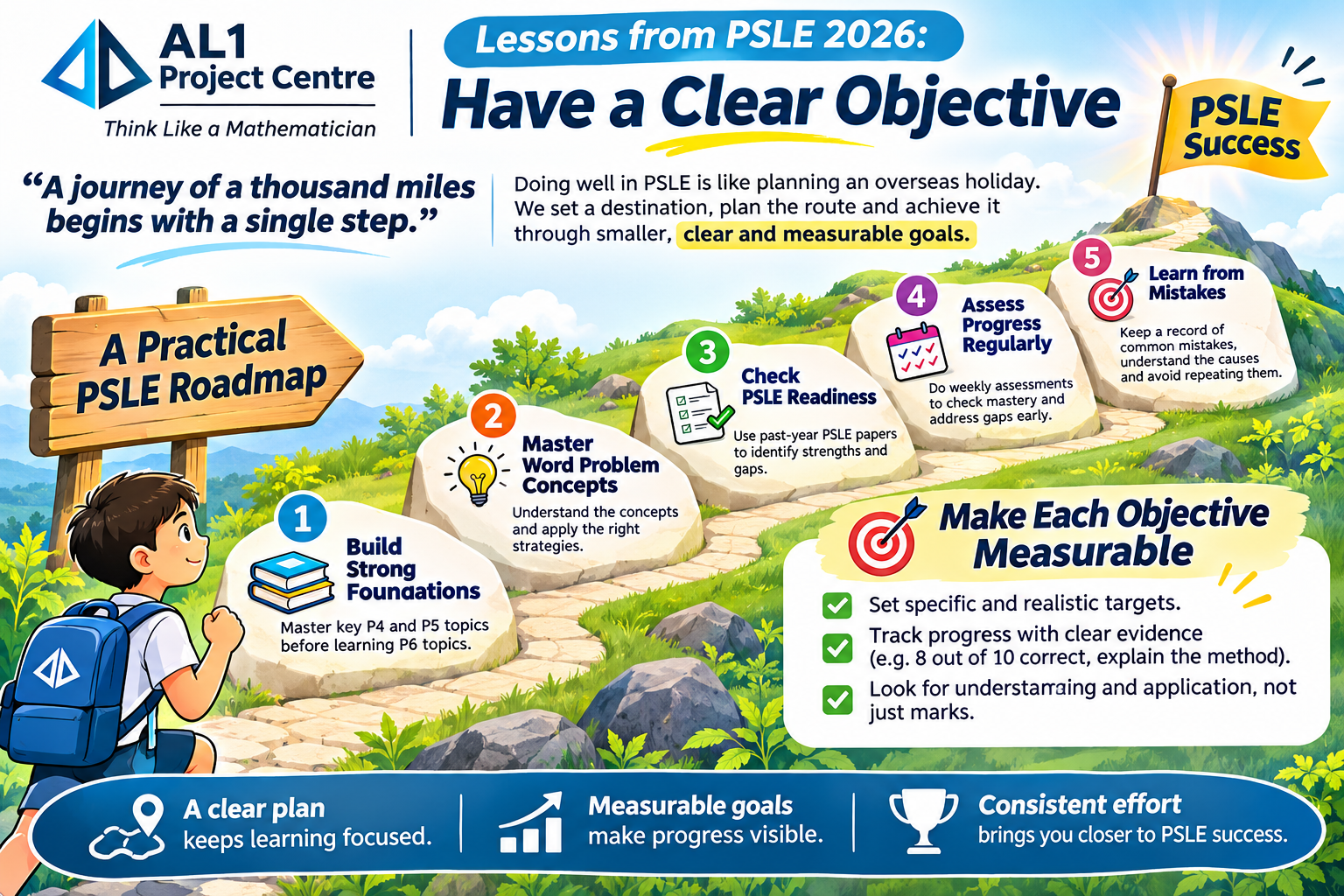
PSLE success begins with a clear roadmap. By setting measurable goals, building strong foundations and tracking progress regularly, every small step brings your child closer to success.
“A journey of a thousand miles begins with a single step.”
Every parent wants their child to do well in the PSLE. However, having a goal is not enough. We need a clear plan to achieve it.
Preparing for the PSLE is much like planning an overseas holiday. We first decide on our destination, then work out the route, the places to visit and the steps needed to get there.
Similarly, PSLE preparation should be a journey with clear objectives and achievable milestones, rather than simply doing more assessment papers and hoping for better results.
Instead of focusing only on the final PSLE score, we can break the journey into smaller, manageable goals.
1. Build Strong Foundations
Before tackling Primary 6 topics, ensure that your child has a good understanding of the important Primary 4 and Primary 5 concepts. Learning becomes more difficult when foundational gaps are left unresolved.
2. Master Word Problem Concepts
Word problems are not just about memorising methods. Children need to understand the mathematical relationships behind the questions and learn when and how to apply different problem-solving strategies.
3. Check PSLE Readiness
Past-year PSLE papers are useful tools to assess readiness. They help identify areas of strength, topics that need further revision and whether children can apply their knowledge independently.
4. Assess Progress Regularly
Weekly assessments provide valuable feedback on whether concepts have been mastered. Rather than waiting until examinations to discover learning gaps, we can identify and address them early.
5. Learn from Mistakes
Encourage your child to keep a record of common mistakes. Are they caused by careless calculation, misunderstanding of concepts or difficulty interpreting questions?
Every mistake is an opportunity to learn, provided we understand why it happened and take steps to avoid repeating it.
6. Make Every Objective Measurable
Setting objectives is important, but we also need a way to measure whether they have been achieved.
For example, instead of simply aiming to "master fractions", set a specific target such as solving 8 out of 10 fraction word problems correctly and independently, while being able to explain the reasoning.
Similarly, rather than aiming to "improve problem-solving skills", identify specific concepts to master and track progress through regular assessments.
When objectives are measurable, progress becomes visible. Parents can identify areas that need attention, while children gain confidence from seeing their own improvement.
However, mastery should not be measured by marks alone. Being able to explain a concept and apply it to unfamiliar problems is equally important.
The Journey Matters as Much as the Destination
A good PSLE preparation plan is not about rushing through as many questions as possible. It is about knowing what needs to be learnt, setting measurable targets, checking progress regularly and making adjustments along the way.
Most importantly, children should be able to see their own progress. Each small achievement builds confidence and motivation for the next challenge.
The goal may be to do well in PSLE 2027, but the focus should be on what we can achieve today, this week and this month.
With clear objectives, measurable milestones, consistent effort and regular reflection, every step brings our children closer to their destination.
Don't just set a PSLE target. Create a roadmap to achieve it.
AL1 Project Centre — Think Like a Mathematician.