PSLE Revision: Why a Systems Thinking Approach Matters
Don’t leave PSLE revision to chance. Build a system, monitor progress and keep adjusting the plan.
We are now in the final countdown to the PSLE.
With only a few weeks left, many parents are asking:
What should my child focus on now?
Should we do more PSLE papers? More prelim papers? More topical revision?
Instead of starting with what paper to do next, we recommend taking a systems thinking approach to PSLE revision.
Don’t Just Revise More. Revise With a System.
Your child is preparing for four subjects, but does each subject need the same amount of revision time?
Probably not.
Start by looking at the bigger picture:
Where is your child now? Where does your child need to be? And what is the best use of the remaining time?
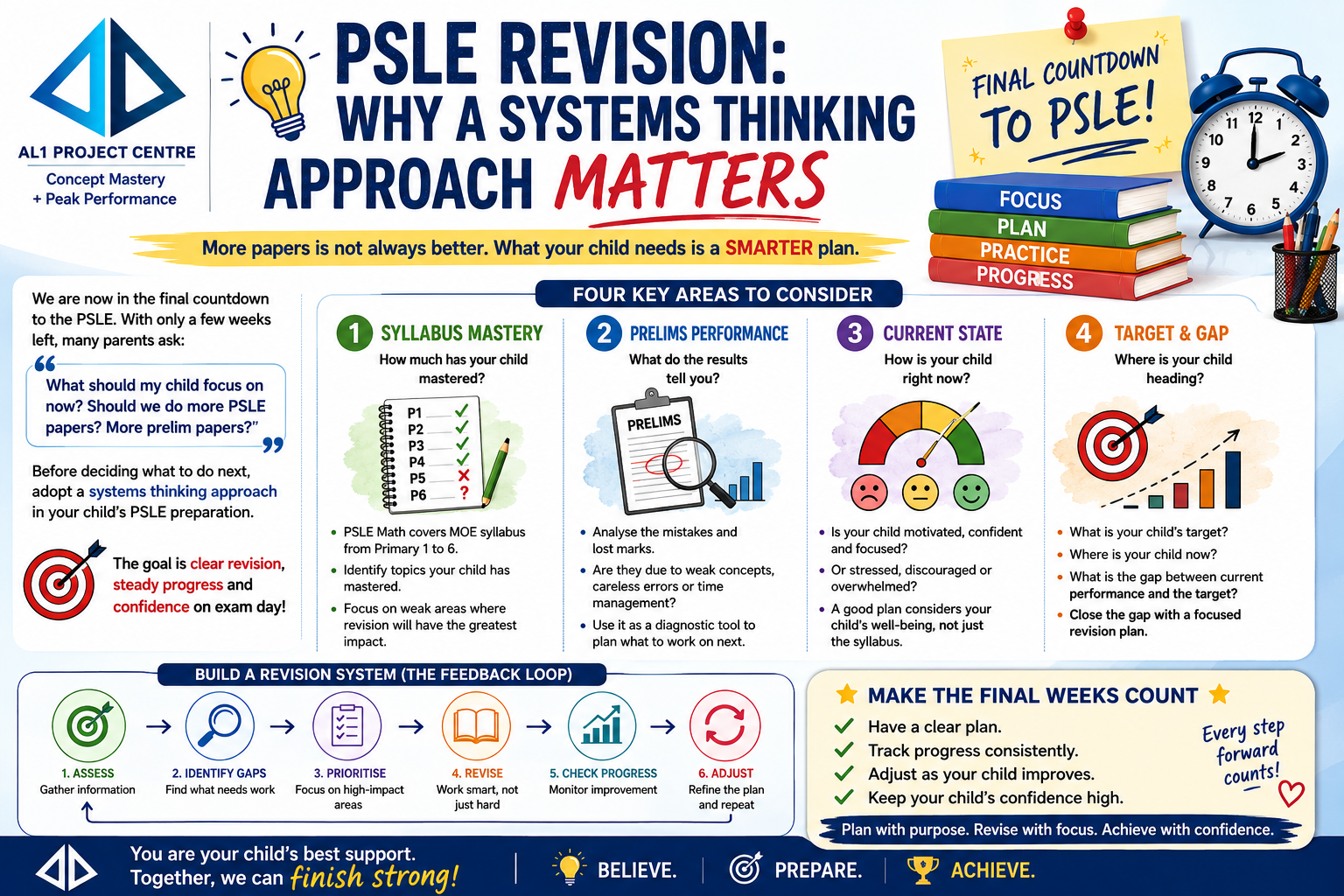
For PSLE Math, consider four areas.
1. How much of the syllabus has your child mastered?
PSLE Math draws on learning from Primary 1 to Primary 6.
At this stage, the goal should not simply be to complete more worksheets. Identify the topics and concepts your child has already mastered—and, more importantly, the areas that are still weak.
This helps you decide where revision time will have the greatest impact.
2. What do the prelim results tell you?
A prelim paper is more than a score.
Use it as a diagnostic tool.
Look at the questions your child lost marks on. Are there particular topics that repeatedly cause difficulty? Are the mistakes due to weak concepts, difficulty applying concepts, careless errors or poor time management?
Instead of simply doing another paper, ask:
What does this paper tell us to work on next?
3. What is your child’s current state?
PSLE preparation is not only about academic knowledge.
Is your child motivated?
Stressed?
Discouraged?
Confident?
A child who knows the mathematics but is overwhelmed or losing confidence may need a very different revision plan from a child who is motivated but still has significant conceptual gaps.
An effective revision system must consider the child, not just the syllabus.
4. What is the target—and what is the gap?
Finally, look at the result your child is working towards.
Where is your child now?
Where does your child want to be?
What is the gap between the two?
Once the gap is clear, revision can become much more focused. Instead of trying to revise everything equally, you can prioritise the areas most likely to help your child move towards the target.
PSLE Revision Should Be a Feedback Loop
A good revision plan is not:
Do paper → mark paper → do another paper.
It should be:
Assess → Identify Gaps → Prioritise → Revise → Check Progress → Adjust
That is the value of a systems thinking approach.
Every paper your child completes should give you information. Every revision session should have a purpose. And the plan should change as your child improves.
With only a few weeks remaining, more revision is not necessarily better revision.
The goal is to make the remaining time count.
Don’t leave PSLE revision to chance. Build a system, monitor progress and keep adjusting the plan.