Why Is My Child Confused by Different Math Methods? The Real Problem Is Weak Conceptual Understanding
Should your child learn multiple ways to solve a math problem? Discover why conceptual understanding matters more than memorising methods and how it leads to long-term success in Singapore Math and PSLE.
The Real Problem Isn’t Multiple Math Methods—It’s Weak Conceptual Understanding
One of the most common concerns we hear from parents is this:
“My child learned one method in school, another from the tutor, and yet a third from me. Now my child is completely confused.”
At first glance, it may seem that the problem is the number of methods being taught. But in reality, the issue is not multiple methods—it is learning methods without first building a strong conceptual foundation.
Different Methods Are Not the Enemy
Take a simple Primary 1 example.
A child is asked to calculate 9 + 4. He reasons:
* 10 + 4 = 14
* 14 − 1 = 13
This is excellent mathematical thinking. The child recognises that 9 is close to 10 and uses that relationship to solve the problem.
Another teacher may present a different strategy:
* Add 1 to 9 to make 10.
* Then add the remaining 3 to get 13.
Both methods are mathematically valid. A child with a solid understanding of number sense should be able to recognise that they are simply different ways of expressing the same idea.
If the child becomes confused by the second method, the problem is not that there are two methods. The problem is that the underlying concept has not yet been fully understood.
The Same Principle Applies to Word Problems
Consider this question:
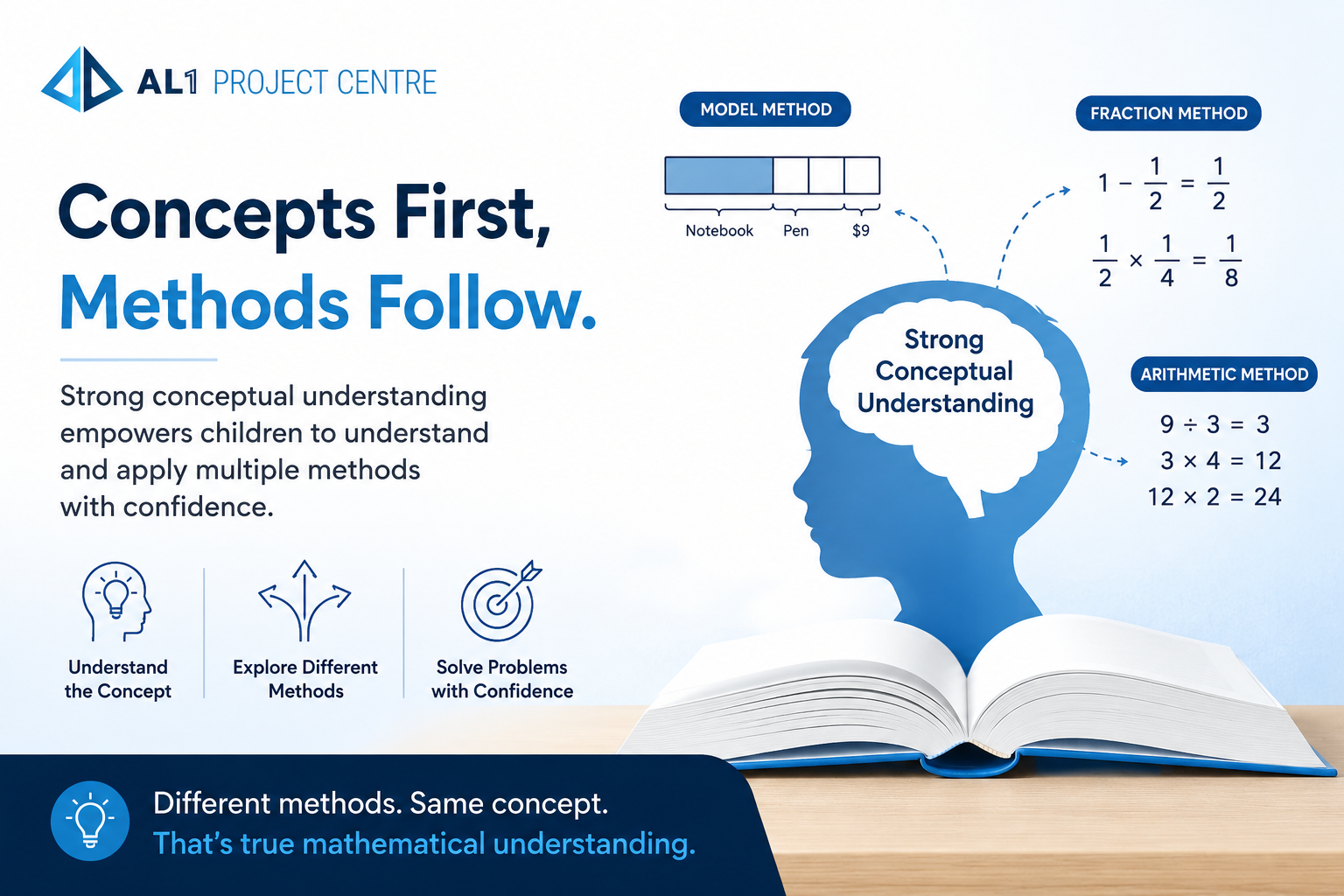
Mark spent half of his money on a notebook. Next, he spent one-quarter of his remaining money on a pen and was left with $9. How much money did he have at first?
Some students may solve it using the model method, while others may use a fraction-based approach. Both methods lead to the correct answer.
The key question is not:
“Which method should my child use?”
Instead, ask:
“Does my child understand why both methods work?”
When concepts are secure, children can move between different representations and strategies with confidence. They begin to see the connections rather than treating each method as a separate procedure to memorise.
Concepts First, Methods Second
Many students struggle because they are taught steps to follow without understanding the mathematical ideas behind them. As a result, they may perform well on familiar questions but become lost when a problem is presented in a different way.
By contrast, children with strong conceptual understanding can:
* Learn new methods quickly.
* Compare different strategies and understand their relationships.
* Adapt to unfamiliar questions.
* Explain their reasoning instead of relying on memorised procedures.
This flexibility is a hallmark of true mathematical mastery.
What Parents Should Focus On
Instead of asking, “Which method is the best?”, ask:
* Does my child understand what each step represents?
* Can my child explain why the method works?
* Can my child recognise the same concept when it is presented differently?
When the concepts are firmly established, learning multiple methods becomes an advantage rather than a source of confusion.
At AL1 Project Centre, we believe that concept mastery comes first. Methods are valuable tools, but they should always be built upon deep understanding. Once children grasp the underlying concepts, they gain the confidence and flexibility to tackle mathematics from different angles and solve problems independently.