Why Children Learn Maths Better by Connecting Ideas
Concept mastery happens when children can link today's lesson to yesterday's knowledge.
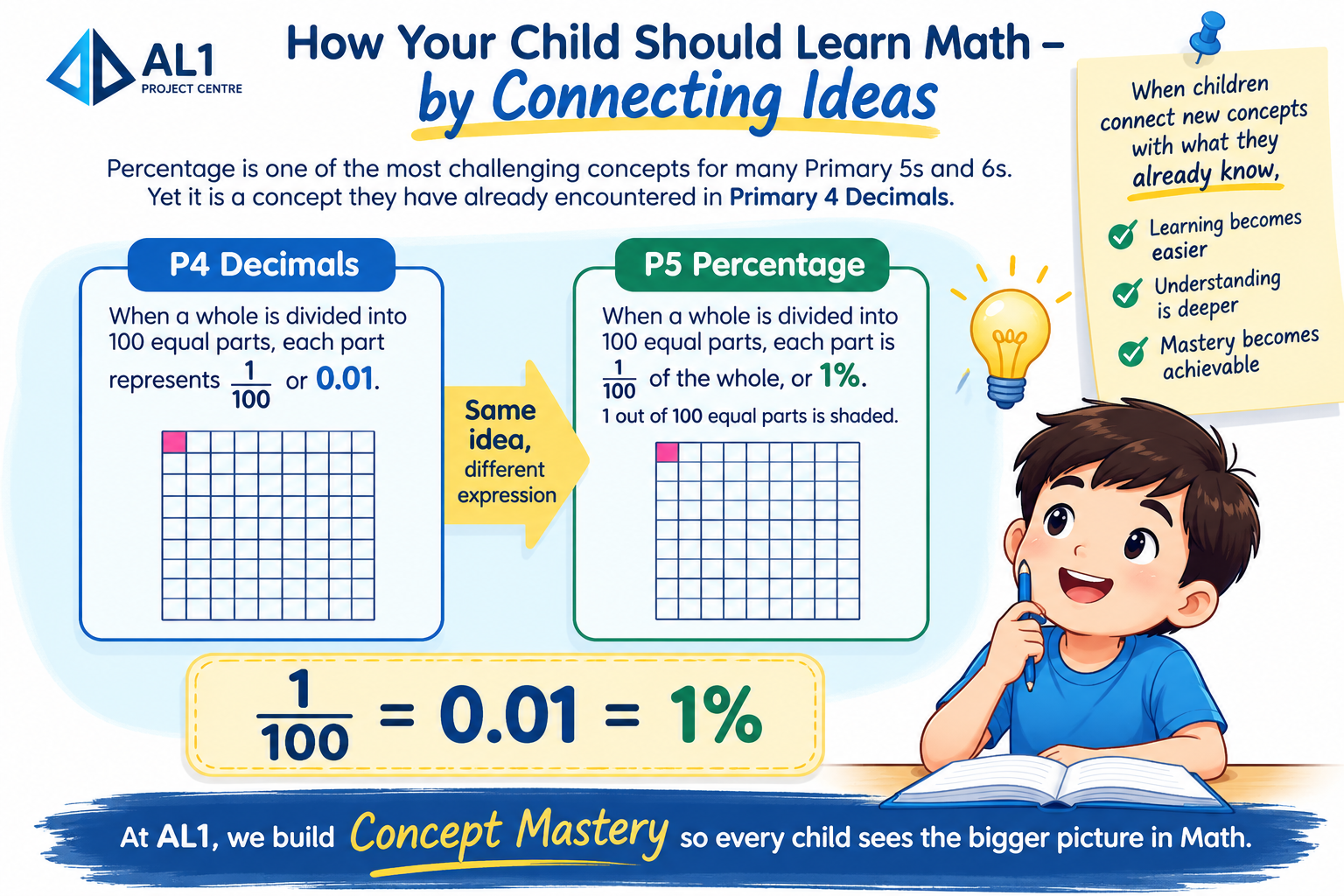
Many Primary 5 and Primary 6 students find percentage one of the most difficult topics in mathematics. Ironically, it isn't actually a completely new concept.
The foundation was already laid in Primary 4 decimals.
In Primary 4, children learn that when a whole is divided into 100 equal parts, each part represents one hundredth (1/100) or 0.01.
A year later, in Primary 5, they learn that when a whole is divided into 100 equal parts, each part also represents 1%.
In other words:
1/100 = 0.01 = 1%
These are not three different ideas—they are simply three different ways of expressing the same concept.
The Secret to Long-Term Mathematical Understanding
Unfortunately, many students are taught mathematics as a series of separate chapters.
Fractions are taught independently.
Decimals are taught independently.
Percentages are taught independently.
As a result, children often feel that every new topic is another formula to memorise.
Strong mathematicians don't learn this way.
They constantly connect new ideas to what they already know.
When children recognise that percentages are simply another representation of hundredths and decimals, the learning process becomes much more natural. Instead of memorising another rule, they build on an existing understanding.
This is exactly how experts learn.
Learning by Connecting Ideas
At AL1 Project Centre, we believe mathematics should be taught as a connected network of ideas, not isolated topics.
When students make these connections:
New concepts become easier to understand.
They remember ideas for much longer.
They become more confident problem solvers.
They rely less on memorisation and more on understanding.
Concept mastery happens when children can link today's lesson to yesterday's knowledge.
The AL1 Difference
Our lessons are designed around one simple philosophy:
Every new concept should connect to a concept your child already understands.
This helps students build a strong mathematical framework instead of collecting disconnected methods.
When learning becomes connected, mathematics becomes meaningful.
And when mathematics becomes meaningful, success follows naturally.