Why Are Fractions So Difficult for Children?
Many children struggle with fractions from P2 to P6. Discover the common reasons why fractions are difficult and how parents can help children build strong fraction concepts.
Why Are Fractions So Difficult for Many Children?
Fractions are one of the most important topics in primary school mathematics. In Singapore, children begin learning fractions as early as Primary 2 and continue developing their understanding all the way to Primary 6. Yet for many students, fractions remain one of the most challenging areas of mathematics.
So why do so many children struggle with fractions?
1. Fractions Are Different from Whole Numbers
For the first few years of school, children work mainly with whole numbers. They learn that bigger numbers represent larger quantities and that addition and subtraction follow predictable rules.
Fractions change those rules.
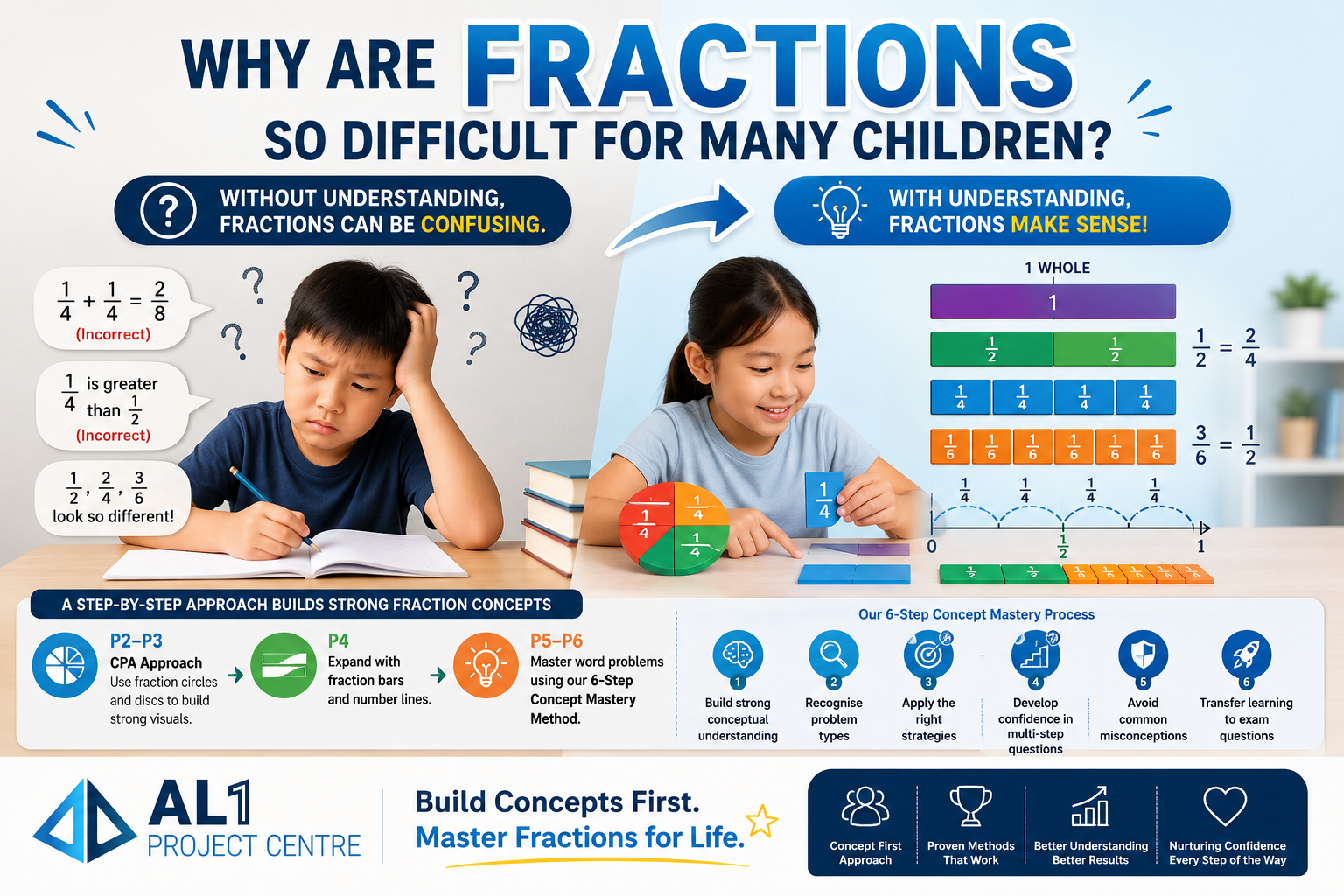
For example, some children see ¼ as two separate numbers rather than one quantity. As a result, they may make mistakes such as:
* ¼ + ¼ = 2/8
* ¼ is greater than ½ because 4 is greater than 2
These errors are common because children are trying to apply whole-number thinking to fractions.
2. Equivalent Fractions Can Be Difficult to Visualise
Another common challenge is understanding equivalent fractions.
Children may learn that:
* ½ = 2/4
* 3/6 = 1/2
However, without strong multiplication skills or visual representations, these fractions can appear completely different.
Many students can memorise the procedure of multiplying the numerator and denominator by the same number, but they do not truly understand why the value remains unchanged.
3. Fractions Require Multiple Representations
Unlike whole numbers, fractions can be represented in many different ways:
* Fraction circles
* Fraction strips
* Fraction bars
* Number lines
* Sets of objects
Children who rely only on procedures often struggle because they cannot connect these different representations to the same underlying concept.
4. Fraction Word Problems Are Often Multi-Step
As students progress to Primary 5 and Primary 6, fraction word problems become increasingly complex.
They are expected to:
* Find fractions of a quantity
* Convert between fractions and whole numbers
* Compare fractions
* Solve multi-step word problems
* Apply model drawing and unitary methods
Many students can perform fraction calculations correctly but become confused when the concepts are embedded within lengthy word problems.
How Can Parents Help Their Child Master Fractions?
The good news is that fractions can be learned successfully when children build their understanding step by step.
Primary 2 and Primary 3: Use the CPA Approach
At the lower primary level, children should learn fractions using the CPA Approach (Concrete-Pictorial-Abstract).
This means using:
* Fraction circles
* Fraction discs
* Hands-on manipulatives
* Visual models
These tools help children develop a strong mental image of what fractions represent before moving on to calculations.
Primary 4: Expand Understanding Through Visual Models
At Primary 4, students should begin working with:
* Fraction bars
* Number lines
* Equivalent fraction models
These representations help children deepen their conceptual understanding and prepare them for more advanced fraction topics.
Primary 5 and Primary 6: Master Fraction Problem-Solving
At the upper primary level, success in fractions depends on more than just calculations.
Students need a systematic approach to analysing and solving word problems.
At AL1 Project Centre, we use our proprietary 6-Step Concept Mastery Process to help students:
1. Build strong conceptual understanding
2. Recognise common problem types
3. Apply the correct strategies
4. Develop confidence in multi-step questions
5. Avoid common misconceptions
6. Transfer their learning to examination questions
Final Thoughts
Fractions are difficult because they require children to think differently from how they think about whole numbers. Without a strong conceptual foundation, students often resort to memorising procedures, which can lead to confusion and mistakes later on.
The key to mastering fractions is not more drilling. It is developing a deep understanding of fraction concepts through visualisation, hands-on learning, and systematic problem-solving.
When children truly understand fractions, they gain the confidence needed to tackle more advanced topics such as ratio, percentage, and algebra in the years ahead.