Why Are Comparison Concepts So Difficult in PSLE Math?
Many children struggle with comparison concepts in PSLE Math. Learn why these questions are difficult and how to build strong problem-solving skills.
Why Are Comparison Concepts So Difficult in PSLE Math?
*"7 is 4 more than ____."*
"Ali has 10 apples. Ali has 2 more apples than Ben. How many apples does Ben have?"
"Gopal and Henry were paid a total of $3,850. Gopal was paid $2,030 more than Henry..."
At first glance, these questions seem very different. However, they all test the same underlying mathematical idea: comparison concepts.
Comparison concepts are introduced as early as Primary 1 and continue to appear throughout Primary School Mathematics. In fact, many of the most challenging PSLE Math word problems are built upon comparison concepts.
Why Do Children Struggle with Comparison Concepts?
One of the biggest misconceptions children have is that they can solve a question simply by looking for keywords.
For example, when they see the phrase "more than", many immediately assume they should add. Unfortunately, this strategy often leads to mistakes.
Consider this question:
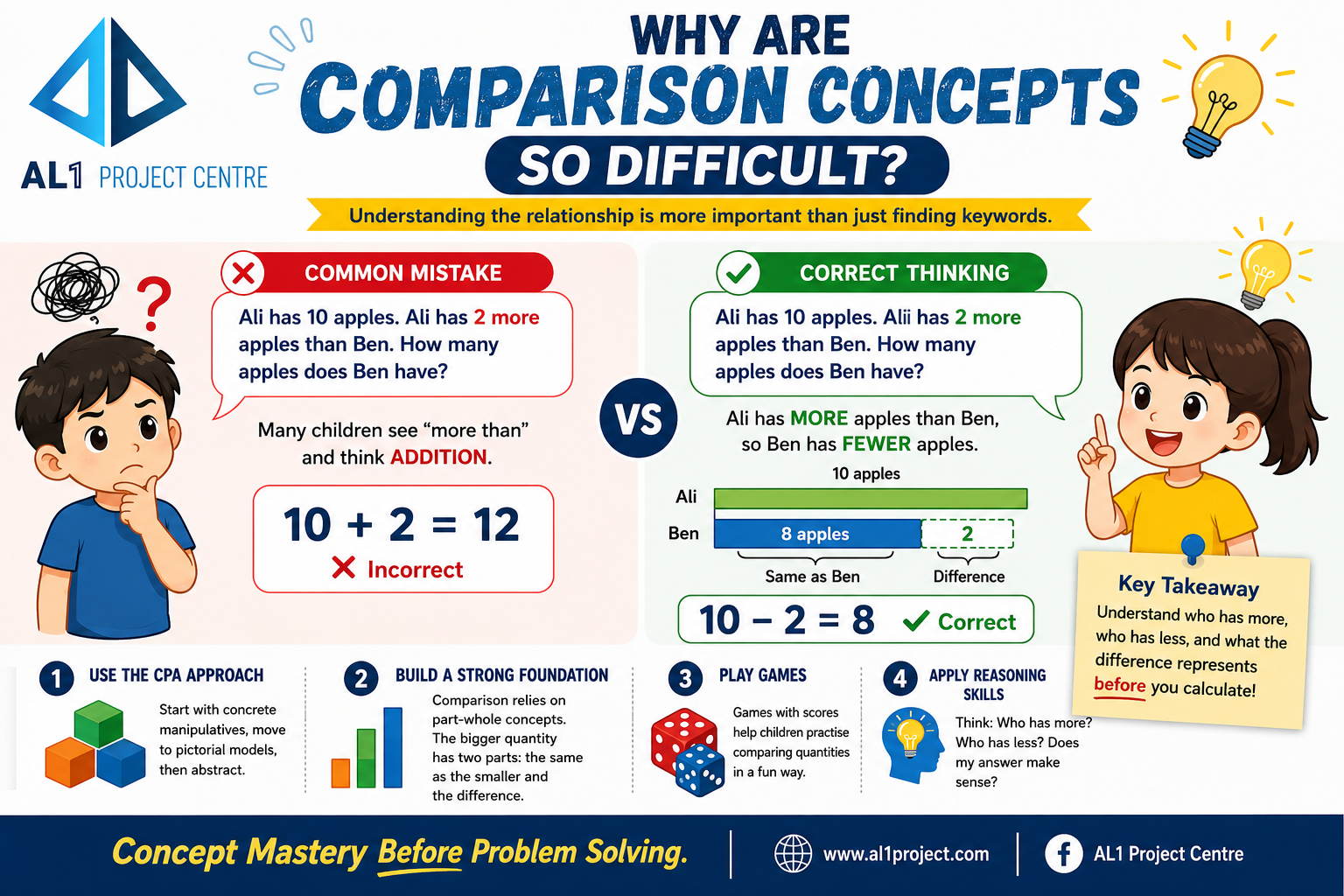
Ali has 10 apples. Ali has 2 more apples than Ben. How many apples does Ben have?
Many children incorrectly calculate:
10 + 2 = 12
However, if Ali has more apples than Ben, Ben must have fewer apples than Ali.
The correct calculation is:
10 − 2 = 8
This demonstrates that understanding the relationship between quantities is more important than simply identifying keywords.
Why Comparison Concepts Remain Difficult Up to PSLE
As children progress through school, comparison questions become increasingly complex.
A simple comparison may involve only two quantities:
* Ali has 2 more apples than Ben.
However, PSLE questions often contain multiple layers of comparison.
For example, a problem may compare:
* Total amount earned
* Difference in earnings
* Number of days worked
* Earnings per day
Children must keep track of several relationships simultaneously. Without a strong conceptual foundation, these questions can quickly become overwhelming.
How to Help Your Child Master Comparison Concepts
1. Use the CPA Approach
Singapore Math is built on the CPA approach:
Concrete → Pictorial → Abstract
Children should first manipulate physical objects, then represent relationships using models and diagrams before solving abstract numerical problems.
This helps them visualise what "more than" and "less than" actually mean.
2. Build a Strong Part-Whole Foundation
Comparison concepts are closely linked to part-whole relationships.
When one quantity is greater than another, the larger quantity can be broken into two parts:
* The same amount as the smaller quantity
* The difference
For example:
Ali: 10 apples
Ben: 8 apples
Ali's 10 apples consist of:
* 8 apples (same as Ben)
* 2 apples (difference)
Children who understand part-whole concepts generally find comparison questions much easier.
3. Encourage Games and Everyday Comparisons
Board games, card games and sports naturally involve comparing scores and quantities.
Questions such as:
* Who scored more points?
* By how many points?
* Who scored fewer points?
help children develop comparison thinking in a fun and meaningful way.
4. Develop Reasoning Before Calculation
Before reaching for a calculator or writing an equation, encourage your child to ask:
* Who has more?
* Who has less?
* What does the difference represent?
* Does my answer make sense?
Strong reasoning skills prevent many common mistakes and build confidence when tackling complex word problems.
The Key to Success in PSLE Math
Many difficult PSLE Math questions are not difficult because of the calculations involved. They are difficult because children do not fully understand the relationships between quantities.
By building a strong foundation in comparison concepts, part-whole thinking, and logical reasoning, children become better equipped to tackle challenging word problems with confidence.
At AL1 Project Centre, our proprietary 6-Step Concept Mastery Programme helps students develop deep conceptual understanding before moving on to advanced problem-solving techniques. This ensures that children do not simply memorise methods but truly understand the mathematics behind them.
When concepts become clear, problem-solving becomes much easier.