How Are Math Learning Gaps Formed? Why Many Children Struggle with Maths
Discover why many children struggle with maths despite practising regularly, and learn how conceptual understanding helps close learning gaps permanently.
How Are Math Learning Gaps Formed? (And Why They Keep Growing)
Many parents search for a maths tuition programme only after their child starts struggling. Naturally, they hope to find a programme that promises quick results. When improvement doesn't happen, they are often left wondering what went wrong.
The truth is that the problem usually isn't a lack of practice.
The real problem is that hidden learning gaps have already formed over many months—or even years.
Instead of looking for promises, parents should look for something far more valuable: an honest diagnosis of their child's conceptual gaps and a clear plan to close them.
What Causes Learning Gaps in Mathematics?
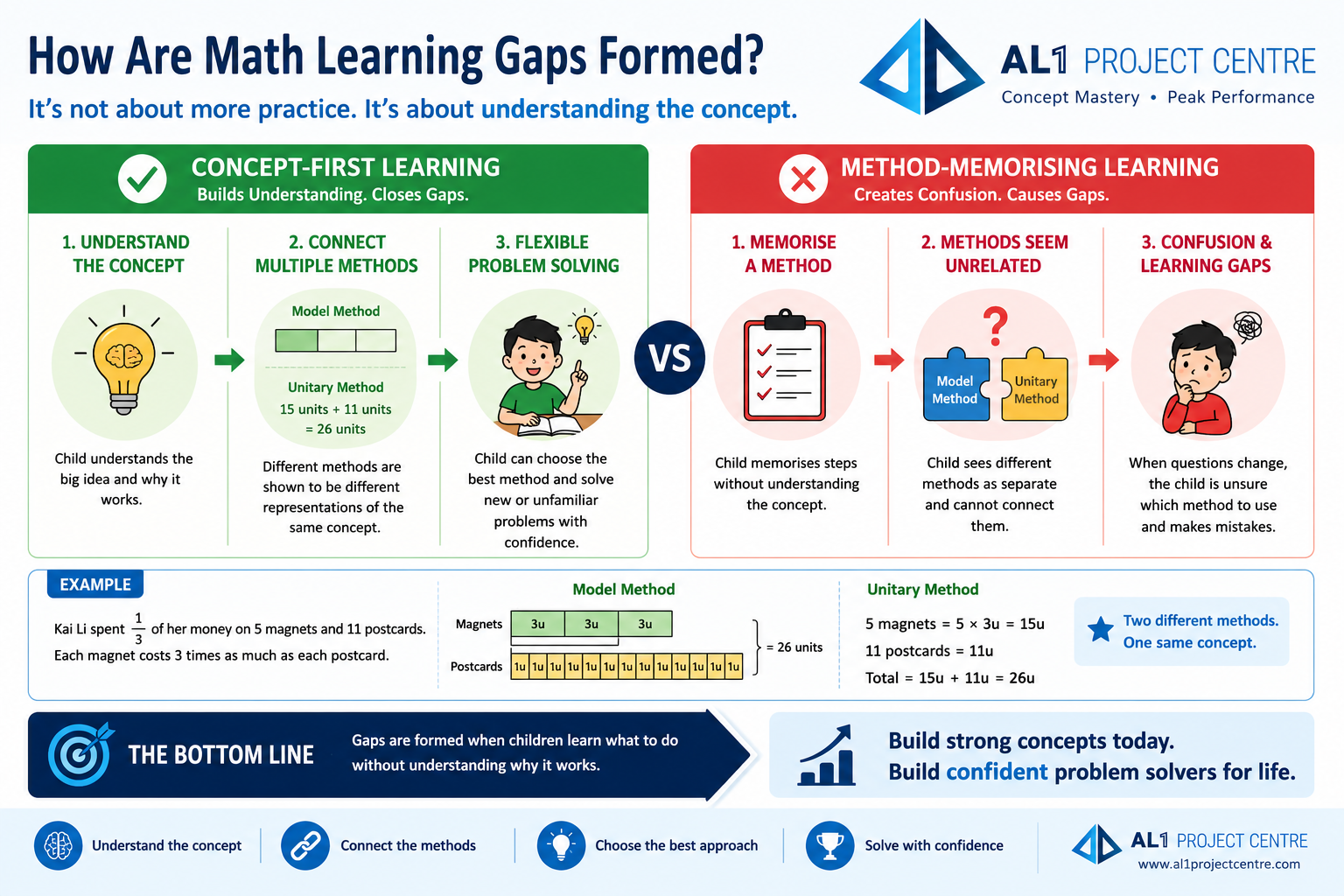
One of the biggest causes of learning gaps is when children learn methods without understanding the mathematical concepts behind those methods.
At first glance, everything seems fine. The child can complete similar questions in class and may even score reasonably well in tests.
However, when the question changes slightly, the child becomes completely lost.
Why?
Because they memorised a procedure instead of understanding the underlying idea.
A Real Example: Model Method vs Unitary Method
Consider this question:
Kai Li spent one-third of her money on 5 magnets and 11 postcards. Each magnet costs 3 times as much as each postcard.
Many children can successfully draw a model to represent the relationship between the magnets and the postcards.
However, when asked to explain the relationship using the unitary method, many become confused.
They fail to recognise that:
* 5 magnets represent 15 units (5 × 3 units)
* 11 postcards represent 11 units
* Therefore, the total cost is 26 units
To the child, Model Method and Unitary Method appear to be two completely different techniques.
In reality, they are simply two different representations of exactly the same mathematical concept.
The problem is not the method.
The problem is that the child never understood the concept connecting both methods.
Why Memorising Methods Eventually Fails
When children memorise isolated procedures, every new topic feels like another method to remember.
Eventually they become overwhelmed.
This is why many Primary 5 and Primary 6 students often say:
* "I don't know which method to use."
* "This question looks different."
* "I've never seen this before."
In reality, they may have seen the concept many times—but only in different forms.
Without conceptual understanding, every variation appears to be a brand-new problem.
How AL1 Project Centre Closes Learning Gaps
At AL1 Project Centre, we believe every mathematical method should grow from a clear concept.
Instead of teaching children to memorise dozens of techniques, we help them understand:
* Why a method works
* How different methods are connected
* When each method should be used
* How one concept can be represented in multiple ways
Once children understand the concept, they become flexible thinkers instead of method collectors.
This not only improves examination performance but also gives them the confidence to solve unfamiliar problems independently.
Final Thoughts
Most mathematical learning gaps do not appear overnight.
They are built slowly whenever a child learns what to do without understanding why it works.
Closing these gaps requires more than additional practice.
It requires rebuilding the child's mathematical understanding from the ground up.
When concepts become clear, methods begin to make sense—and confident problem solving naturally follows.