Why the AL1 6-Step Concept Mastery Process Goes Beyond Polya's 4-Step Problem-Solving Method
Discover how the AL1 6-Step Concept Mastery Process builds deeper mathematical understanding than traditional problem-solving methods, helping students master challenging PSLE and Singapore Math word problems with confidence.
For decades, educators around the world have relied on Polya's famous 4-Step Problem-Solving Process to teach students how to tackle mathematical word problems. Developed by renowned mathematician George Polya, this framework remains one of the most influential approaches in mathematics education.
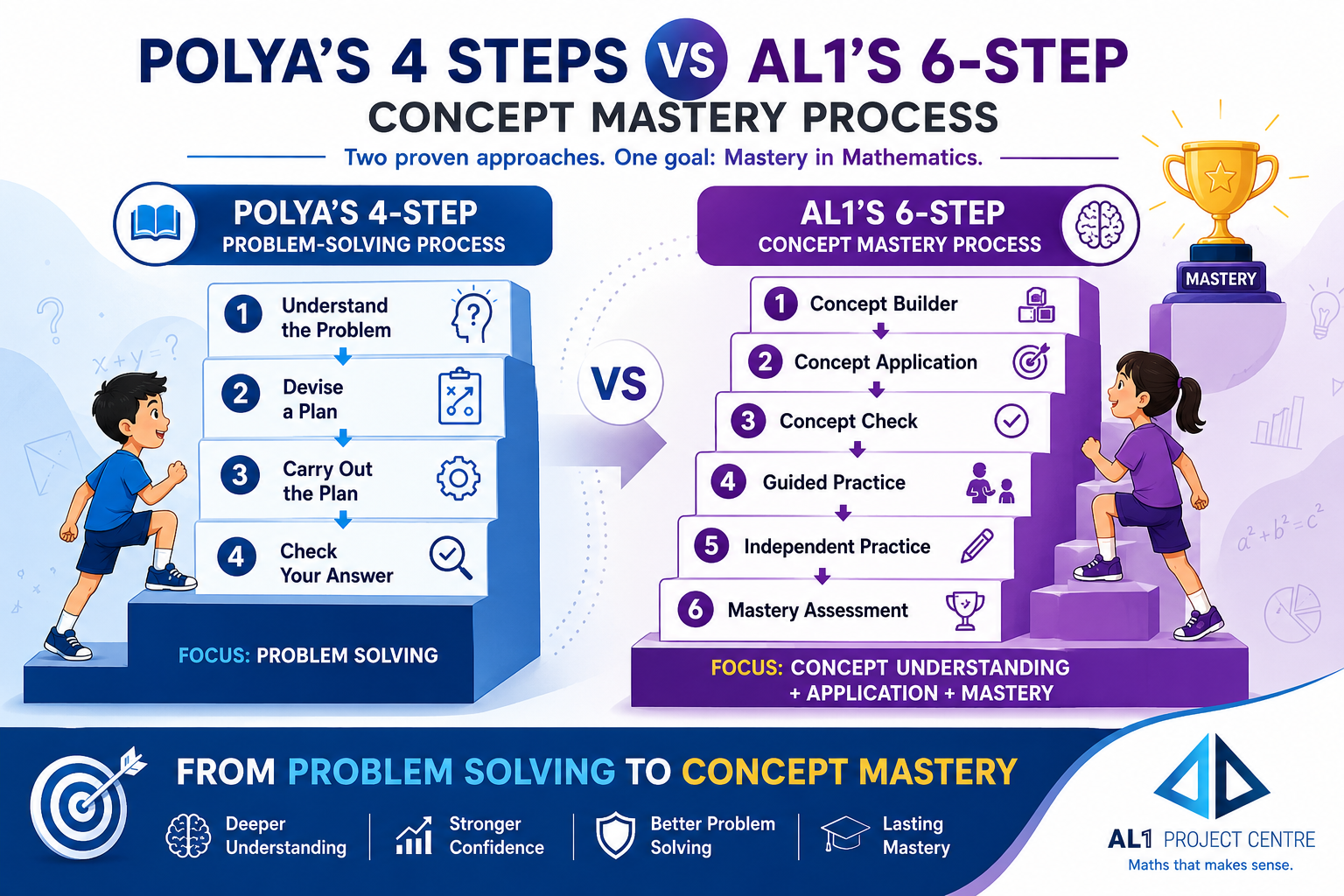
The four steps are:
1. Understand the Problem
2. Devise a Plan
3. Carry Out the Plan
4. Look Back and Check
A strong problem solver should be able to understand the problem, select an appropriate strategy, solve it accurately, and verify that the answer makes sense.
At AL1 Project Centre, we deeply respect Polya's contribution to mathematics education. In fact, our proprietary 6-Step Concept Mastery Process is built upon the same philosophy. However, through years of working with primary school students, we observed that many children struggle not because they lack problem-solving strategies, but because they have not yet developed a deep understanding of the mathematical concepts behind those strategies.
As a result, we expanded Polya's framework into a more structured and scaffolded learning process that systematically develops understanding, application, confidence, and mastery.
The AL1 6-Step Concept Mastery Process
Step 1: Concept Builder
Before students can solve a problem, they must first understand the underlying mathematical concept.
At this stage, students explore concepts using concrete examples, visual representations, discussions, and guided discovery activities. The goal is to help students build meaningful understanding rather than memorise procedures.
Step 2: Concept Application
Once students understand the concept, they learn when and how to apply it.
Students are exposed to a variety of situations where the same concept appears in different forms. This helps them recognise patterns and develop flexibility in their thinking.
Step 3: Concept Check
Many students rush through questions without checking their work. In traditional problem-solving approaches, checking is often treated as the final step and is frequently neglected.
At AL1, we deliberately bring this step forward and emphasise it early in the learning process. Students learn to evaluate their thinking, identify errors, and justify their solutions before misconceptions become habits.
Step 4: Guided Practice
Students practise with teacher support and scaffolding.
The teacher models thought processes, asks guiding questions, and provides feedback. This helps students bridge the gap between understanding a concept and applying it independently.
Step 5: Independent Practice
Students now apply what they have learned on their own.
Through carefully sequenced exercises, they build confidence, fluency, and accuracy while developing ownership of their learning.
Step 6: Mastery Assessment
The final stage evaluates whether genuine mastery has been achieved.
Students demonstrate their ability to apply concepts independently across a variety of contexts and problem types. This ensures that learning is retained and transferable beyond the classroom.
Comparing Polya's 4 Steps and the AL1 6-Step Process
| Polya's Framework | AL1 6-Step Concept Mastery Process |
| ---------------------- | ----------------------------------------------------------- |
| Understand the Problem | Concept Builder |
| Devise a Plan | Concept Application |
| Carry Out the Plan | Guided Practice + Independent Practice + Mastery Assessment |
| Look Back and Check | Concept Check (emphasised earlier in the learning cycle) |
Why the AL1 Approach Works
While Polya's framework focuses primarily on the problem-solving process, the AL1 6-Step Concept Mastery Process focuses on both concept development and problem-solving.
Many students struggle with mathematics because they are asked to solve problems before they fully understand the concepts involved. Our approach slows down the learning process initially, allowing students to develop deeper conceptual understanding before progressing to more challenging applications.
The result is a graduated learning pathway that:
* Builds stronger conceptual understanding
* Reduces reliance on memorisation
* Improves confidence in tackling unfamiliar problems
* Encourages reflective thinking and self-correction
* Develops independent learners
* Promotes long-term retention and mastery
From Problem Solving to Concept Mastery
At AL1 Project Centre, we believe that successful problem solving begins with conceptual understanding.
Rather than teaching students to memorise methods, we teach them to understand why mathematical concepts work and how they can be applied in different situations.
Our 6-Step Concept Mastery Process provides the scaffolding that many students need to move from confusion to confidence and ultimately achieve mastery in mathematics.
Because when children truly understand a concept, they do not simply solve today's problem—they gain the ability to solve tomorrow's challenges as well.