Why Smart Children Still Struggle With PSLE Math Word Problems (And How Parents Can Help)
Many intelligent children struggle with PSLE Math because they rely on keywords and memorisation instead of mathematical reasoning. Learn how to help your child think like a problem solver.
Why Smart Children Still Struggle With PSLE Math Word Problems
Have you ever wondered why an intelligent child who excels in English, Science, and Mother Tongue still struggles with Mathematics?
At AL1 Project Centre, we meet many students who fit this profile. They are hardworking, articulate, and curious, yet they find PSLE Math word problems frustrating and confusing. Parents are often puzzled and ask, “My child is smart. Why can’t they do well in Math?”
The answer often lies not in intelligence, but in how the child has learned mathematics.
Math Is About Reasoning, Not Just Calculating
Success in Mathematics depends on more than knowing how to add, subtract, multiply, or divide. Children must also develop mathematical reasoning—the ability to think logically about relationships between numbers and situations.
Consider this simple question:
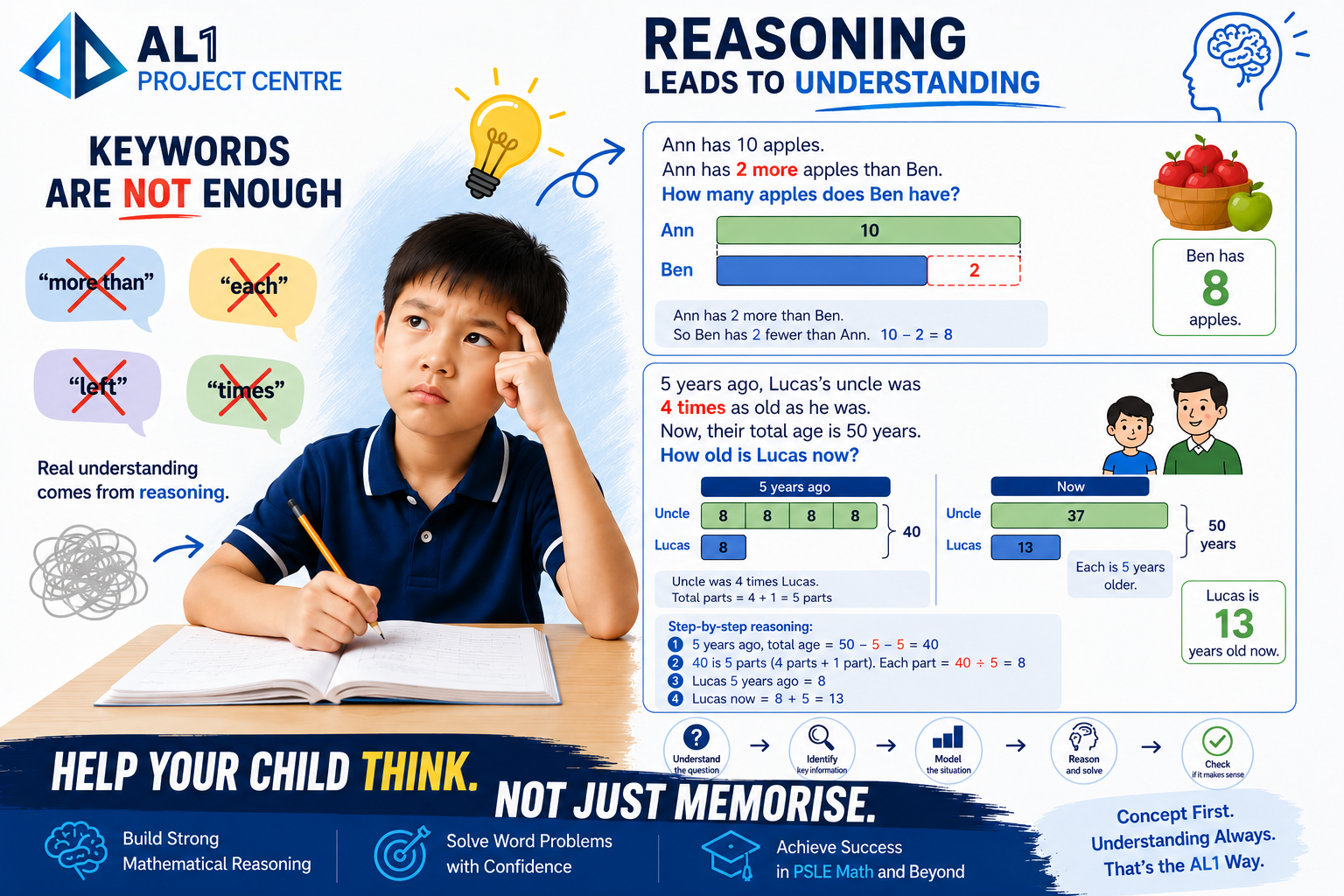
Ann has 10 apples. Ann has 2 more apples than Ben. How many apples does Ben have?
Many children answer 12 because they associate the phrase “more than” with addition. However, the correct answer is 8. If Ann has 2 more apples than Ben, then Ben must have 2 fewer apples than Ann.
This mistake is common among Primary 1 and Primary 2 students and highlights an important issue: many children rely on keyword spotting instead of genuine understanding.
The Problem With Keyword Strategies
Some children are taught shortcuts such as:
* “More than” means add.
* “Left” means subtract.
* “Each” means multiply.
While these hints may occasionally work, they often break down in more complex questions.
When students depend on keywords rather than reasoning, they become vulnerable to tricky word problems that require careful interpretation.
A More Challenging Example
Consider this Primary 4 problem:
Five years ago, Lucas’s uncle was four times as old as Lucas. Today, their total age is 50 years. How old is Lucas now?
A common incorrect approach is to subtract 5 from 50 and then divide by 5.
The flaw is that both people were 5 years younger, so their combined age five years ago was reduced by 10 years, not 5. Solving the problem correctly requires students to understand the situation before choosing a method.
This is mathematical reasoning in action.
Why Some Bright Children Continue to Struggle
Children who have not been trained to think mathematically often compensate by memorising procedures or searching for familiar keywords. These strategies may work on routine exercises but become unreliable when faced with unfamiliar or multi-step problems.
As the curriculum progresses into Primary 5 and PSLE, questions increasingly test understanding rather than memorisation. Students who lack strong reasoning skills may suddenly find that their old methods no longer work.
Building Strong Problem Solvers
Instead of asking, “Which operation should I use?”, encourage children to ask:
* What is the problem really telling me?
* Who has more and who has less?
* How are the quantities related?
* Does my answer make sense?
By developing these habits, children become confident problem solvers who can tackle unfamiliar questions with understanding instead of guesswork.
At AL1 Project Centre, our teaching focuses on conceptual understanding and mathematical reasoning, helping students build the thinking skills needed not only for PSLE Math but for lifelong learning.
Remember: Smart children do not struggle because they lack ability. More often, they struggle because they have been taught to memorise instead of to think.