Why Many Children Struggle with Math in Primary 3: The Importance of Early Diagnostic Assessment
Discover why many children struggle with Primary 3 Math and how a diagnostic assessment can identify learning gaps before they become bigger problems.
Why Many Children Struggle with Math in Primary 3 — And Why Early Diagnosis Matters
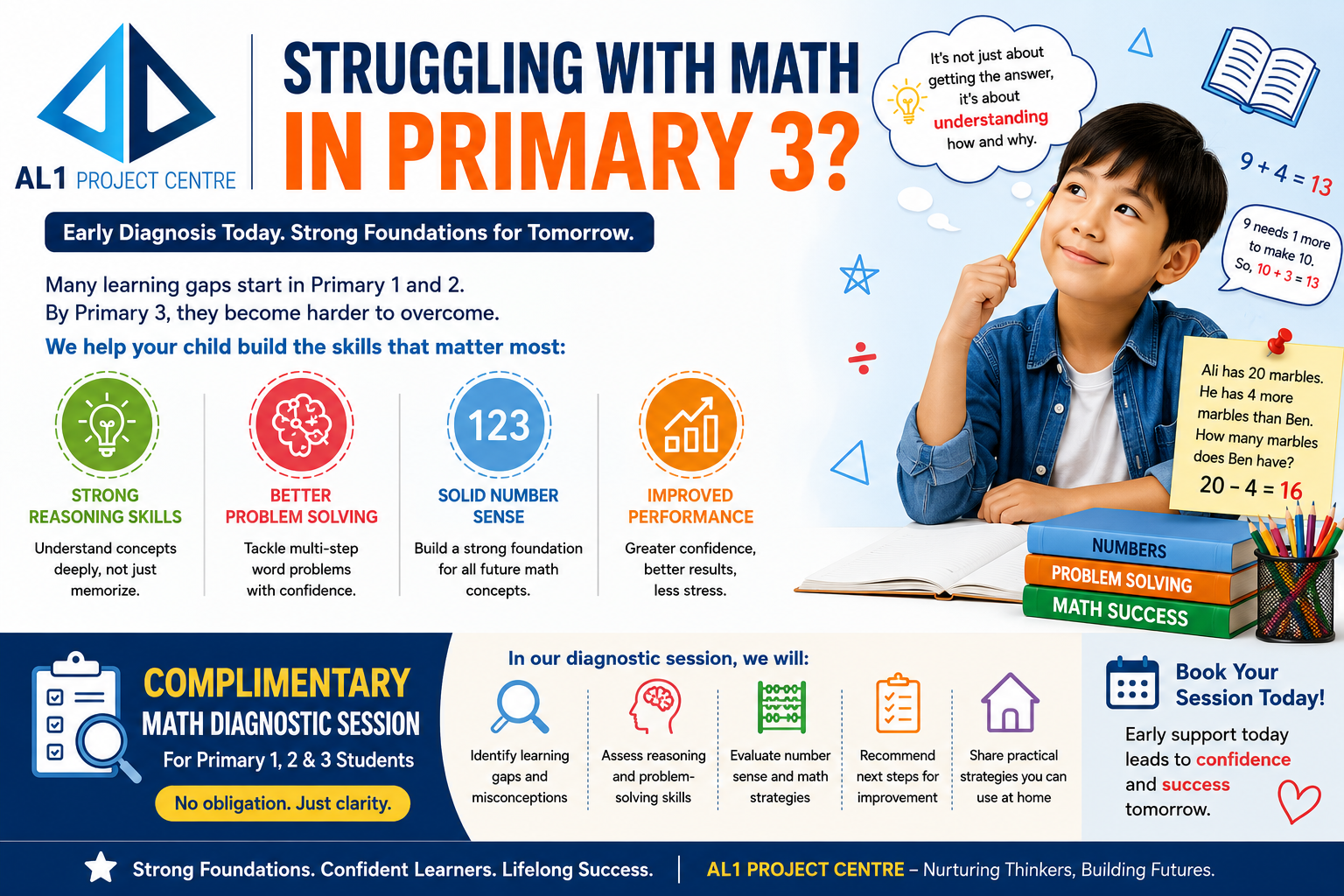
Many parents are surprised when their child suddenly starts struggling with Mathematics in Primary 3.
In Primary 1 and Primary 2, their child may have been coping reasonably well. Then, almost overnight, Math becomes difficult. Test scores begin to drop, confidence takes a hit, and homework becomes a daily battle.
But here's the truth:
Math does not suddenly become difficult in Primary 3.
In most cases, the learning gaps were already present in Primary 1 or Primary 2. The difference is that these gaps become much more visible when the demands of the syllabus increase.
Why Primary 3 Is a Major Turning Point
Primary 3 introduces several new challenges:
* Multiplication and division
* More complex calculations
* Multi-step word problems
* Greater emphasis on mathematical reasoning
Strategies that may have worked in Primary 1 and Primary 2 often become ineffective.
For example, some children still rely on finger counting to solve addition and subtraction questions. While this may work for simple calculations, it quickly becomes too slow and inaccurate when multiplication and division are introduced.
As a result, many students begin to feel overwhelmed and lose confidence in Mathematics.
The Hidden Problem: A Lack of Mathematical Reasoning
When we conduct diagnostic assessments, we often discover that the issue is not a lack of effort.
Instead, many children have not developed strong mathematical reasoning skills.
Consider this simple question:
What is 9 + 4?
Many children can answer "13" correctly.
However, when we ask them how they got the answer, they often reply:
* "I counted my fingers."
* "I memorised it."
While the answer is correct, the reasoning behind it may be weak.
A child with strong number sense might explain:
"9 needs 1 more to become 10, so I moved 1 from 4 to make 10 + 3 = 13."
This demonstrates understanding rather than memorisation.
Why Word Problems Become Difficult
The same issue appears in word problems.
Consider this question:
Ali has 20 marbles. He has 4 more marbles than Ben. How many marbles does Ben have?
Many children immediately see the phrase "more than" and perform addition:
20 + 4 = 24
This answer is incorrect.
Children who apply reasoning will think differently:
* Ali has more marbles than Ben.
* Therefore, Ben must have fewer marbles than Ali.
* So we subtract 4 from 20.
20 − 4 = 16
The correct answer is 16 marbles.
This example highlights an important point:
Mathematics is not about spotting keywords. It is about understanding relationships.
The Importance of Building Strong Foundations in Primary 1 and Primary 2
Many children are taught procedures and methods but are not taught how to think mathematically.
As a result, they may rely heavily on:
* Memorisation
* Guesswork
* Keyword spotting
* Trial-and-error methods
These strategies may produce correct answers in the early years, but they eventually break down when questions become more complex.
At AL1 Project Centre, we believe that strong mathematical performance begins with strong reasoning skills.
That is why our teaching focuses on helping children understand concepts deeply rather than simply memorising methods.
How We Help Children Develop Mathematical Reasoning
One of the most effective approaches for developing conceptual understanding is the CPA Approach (Concrete-Pictorial-Abstract).
This approach helps children:
* Understand concepts using hands-on materials
* Visualise mathematical relationships
* Progress confidently towards abstract calculations
You can learn more about the CPA Approach in our article:
"Why Many Children Struggle with Math in Primary 3: Understanding Scaffolding"
Complimentary Math Diagnostic Assessment for Primary 1 to Primary 3 Students
If your child is struggling with Mathematics—or if you simply want to ensure they are building strong foundations—we invite you to attend a complimentary diagnostic assessment.
During the session, we will:
✓ Identify learning gaps and misconceptions
✓ Assess your child's mathematical reasoning skills
✓ Evaluate number sense and problem-solving strategies
✓ Recommend practical next steps for improvement
✓ Share strategies parents can use at home
Our goal is not simply to identify weaknesses, but to help every child develop the confidence, understanding, and reasoning skills needed to succeed in Mathematics.
Book Your Complimentary Diagnostic Session Today
Whether your child is in Primary 1, Primary 2, or Primary 3, an early diagnosis can prevent small learning gaps from becoming major obstacles later on.
Contact AL1 Project Centre today to schedule your complimentary diagnostic assessment and discover how your child can build a strong foundation for long-term success in Mathematics.