When Emotions Run High, Exam Scores Do Not
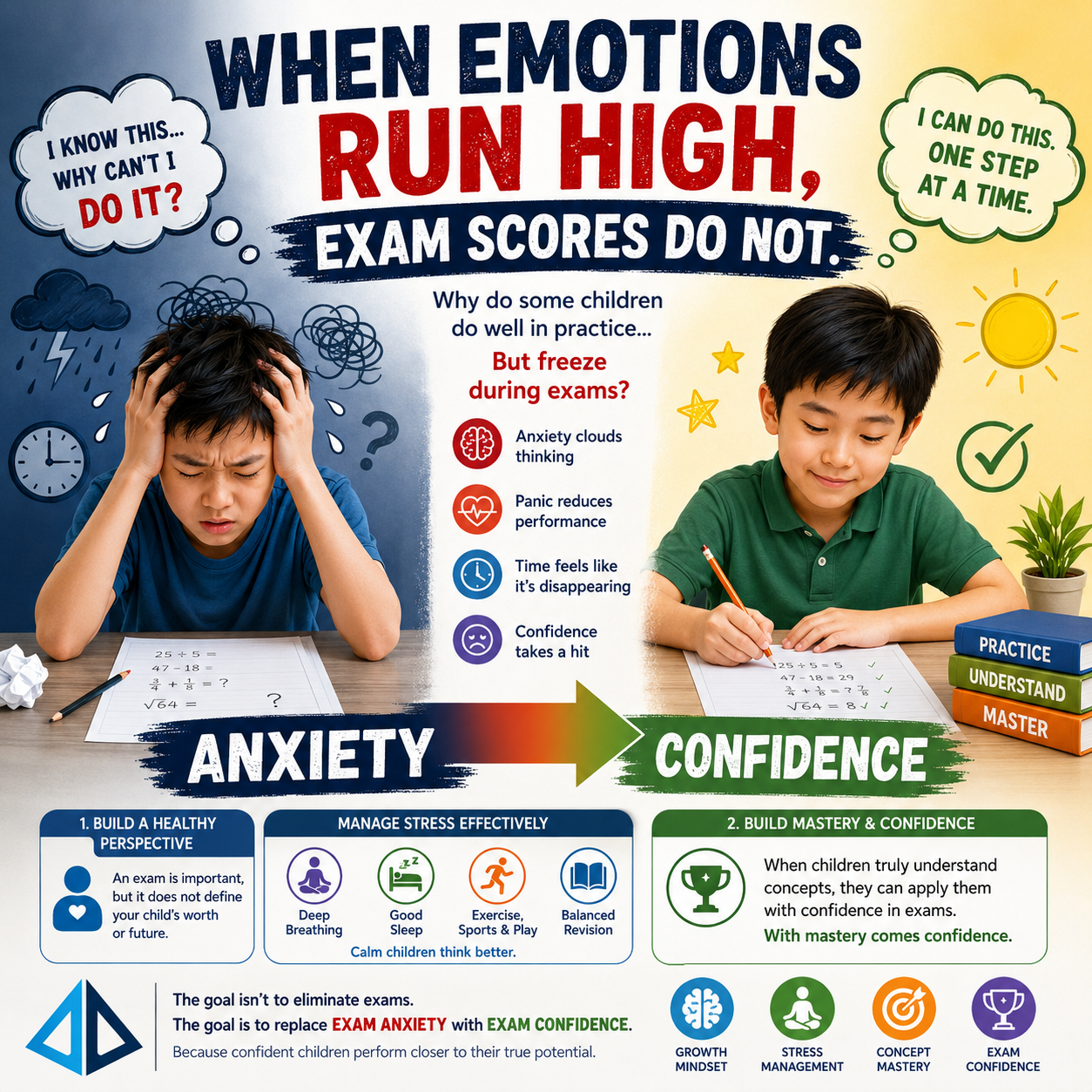
When children develop both emotional resilience and academic mastery, they are able to perform much closer to their true potential. Find out how you can help your child overcome exam anxiety with simple but effective strategies.
Have you ever wondered why your child performs well during practice sessions, yet struggles to deliver the same results during tests and examinations?
Many parents find this puzzling. Their child attends lessons regularly, completes homework diligently, and appears to understand the concepts being taught. Yet when the exam paper is placed in front of them, something changes.
For some children, the issue is not a lack of ability. It is exam anxiety.
What Happens During Exam Anxiety?
Imagine a child sitting in an examination hall. They come across a question they have seen before. They know they have learned it, but the answer does not come to mind immediately.
At that moment, their brain can trigger a fight-or-flight response.
The child begins to panic. Their heart races. Their thoughts become clouded. Instead of calmly applying what they know, they become overwhelmed by emotions.
As anxiety increases, their ability to think clearly decreases.
One difficult question leads to another. Confidence drops. Time seems to pass more quickly. Before long, the entire paper feels impossible.
Many children leave the examination hall feeling defeated, even though they were capable of solving many of the questions under normal circumstances.
Why Is Exam Anxiety So Debilitating?
Some children unconsciously view examinations as high-stakes, life-or-death situations.
Although they may understand logically that one examination will not determine their future, their emotional response tells them otherwise.
When emotions take over, rational thinking becomes much harder. This is why children who are perfectly capable during lessons can struggle significantly during examinations.
How Can Parents Help?
1. Develop a Healthy Perspective Towards Examinations
Examinations are important, but they do not define a child's worth, intelligence, or future success.
Children benefit greatly when parents focus on effort, improvement, and learning rather than solely on grades.
Developing a growth mindset helps children view challenges as opportunities to learn rather than threats to avoid.
Parents can also encourage healthy stress-management habits such as:
Adequate sleep
Regular physical exercise
Deep breathing techniques
Sports and recreational activities
Balanced study schedules
A calmer mind is better able to access what it already knows.
2. Build Genuine Mastery
Confidence is not built through reassurance alone. It is built through mastery.
When children have a deep understanding of concepts and sufficient practice applying them in different situations, they approach examinations with greater certainty and composure.
In mathematics, this means going beyond memorising procedures. Children need to understand concepts, recognise patterns, and learn how to apply strategies effectively to solve unfamiliar problems.
As mastery grows, confidence grows alongside it.
Replacing Anxiety with Confidence
The goal is not to eliminate examinations. The goal is to equip children with the skills and mindset needed to approach examinations calmly and confidently.
When children develop both emotional resilience and academic mastery, they are able to perform much closer to their true potential.
At AL1 Project Centre, we believe that confidence is built through understanding. Our programmes focus on helping children master mathematical concepts, strengthen problem-solving skills, and develop the confidence needed to tackle examinations with a positive mindset.
Because the best way to overcome exam anxiety is to replace it with exam confidence.