The Shocking Truth About Math Learning That Many Parents Don’t Realise
Discover why memorising times tables isn't enough and how numerical reasoning helps children excel in PSLE Math and solve word problems confidently.
The Shocking Truth Many Parents Don’t Realise About Learning Mathematics
Why Memorising Math Facts Alone Is Not Enough
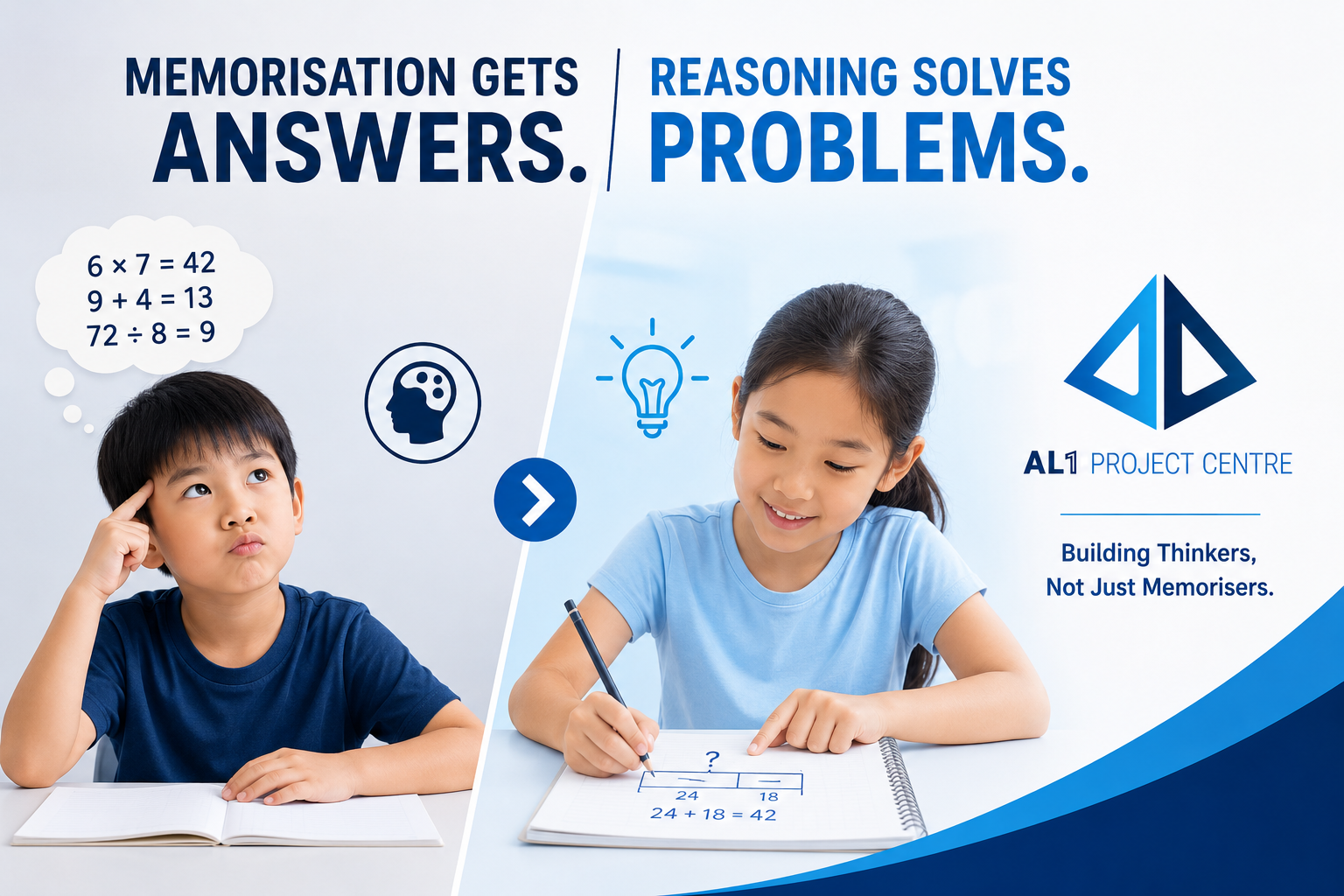
When parents think about doing well in mathematics, they often focus on memorising multiplication tables, number facts, and formulas. While these are certainly important, they are only one piece of the puzzle.
At AL1 Project Centre, one of the first things we do during a diagnostic assessment is evaluate a child's numerical reasoning. We might ask seemingly simple questions such as:
* 9 + 4
* 13 – 6
* 6 × 7
* 72 ÷ 8
Many children answer correctly. But our next question is often even more revealing:
“How did you work it out?”
Surprisingly, a large number of students reply, “I memorised it.”
The Hidden Skill Behind Success in Mathematics
Getting the correct answer is good, but understanding why the answer is correct is far more important.
Numerical reasoning is the ability to think logically about numbers, recognise patterns, and make connections between concepts. This same thinking process is what enables children to solve challenging word problems, multi-step questions, and unfamiliar exam situations.
In other words:
Strong numerical reasoning is the foundation of strong mathematical reasoning.
Unfortunately, many parents fail to recognise this connection.
“My Child Knows the Times Tables… So Why Can't They Solve Word Problems?”
This is one of the most common questions we hear.
A child may know that 6 × 7 = 42, but struggle when faced with a problem requiring them to decide whether multiplication is the correct operation to use.
The issue is not language ability. In many cases, the real challenge is mathematical reasoning—understanding relationships, identifying patterns, and choosing an appropriate strategy.
Memorisation tells children what the answer is.
Reasoning helps them understand why it works and when to apply it.
The Problem with Rote Learning
Traditional learning often encourages students to memorise procedures or copy methods without fully understanding them. This approach may produce short-term gains but frequently breaks down when students encounter unfamiliar questions.
Modern mathematics education demands much more than recall. Students are expected to analyse, interpret, and apply concepts in different contexts.
Without conceptual understanding, children often become stuck when a question is presented in a new way.
How Parents Can Help Their Children Build Real Mathematical Thinking
Instead of asking only, “What’s the answer?”, try asking:
* “How did you get that answer?”
* “Can you solve it another way?”
* “Why does that method work?”
* “Can you explain it to me?”
These conversations encourage children to think deeply and develop flexible problem-solving skills.
When children reason with numbers instead of simply memorising them, they gain confidence, become more adaptable learners, and are better equipped to tackle higher-level mathematics.
The AL1 Approach: Building Thinkers, Not Just Memorisers
At AL1 Project Centre, we believe true mathematical success comes from understanding, not rote learning.
Our programmes focus on developing conceptual mastery and numerical reasoning so that students can confidently solve both routine calculations and challenging word problems. By strengthening the thinking behind the mathematics, children become independent problem solvers who are prepared for school assessments and beyond.
Final Thoughts
Memorising facts has its place, but it should never be the end goal.
The real objective is to help children think mathematically.
When students understand the reasoning behind numbers, they don't just remember mathematics—they truly learn it. And that understanding becomes the foundation for long-term success in PSLE Math and beyond.