The 3 Most Common PSLE Math Mistakes Children Make (And How to Overcome Them)
Discover the 3 most common PSLE Math mistakes children make and learn practical strategies to improve confidence, understanding, and exam performance.
The 3 Most Common PSLE Math Mistakes Children Make (And How to Overcome Them)
Every year, many students walk into their PSLE Math examination hoping to achieve their target grade. They study hard, attend lessons, complete worksheets, and revise before the exams.
Yet when the results are released, many are disappointed.
Why does this happen?
There is a Chinese saying, 力不从心, which describes a situation where the heart desires something, but the ability to achieve it falls short.
In Mathematics, most children genuinely want to do well. However, their performance is often held back by recurring mistakes that repeatedly cost them marks.
After teaching Mathematics for over 25 years, I have found that most students' errors fall into three main categories.
Understanding these mistakes is the first step towards helping your child improve.
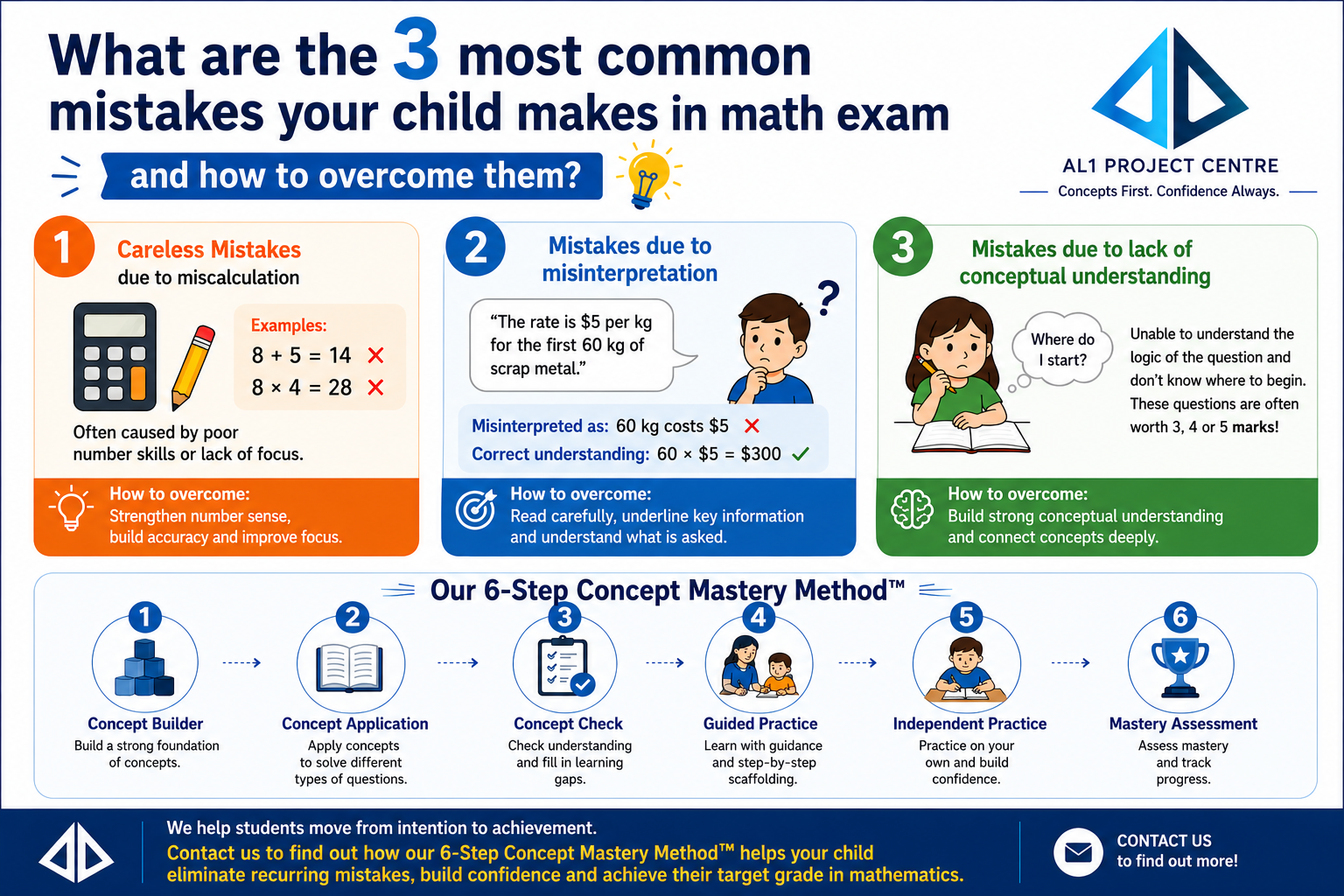
1. Careless Mistakes Due to Weak Number Skills or Poor Focus
These are mistakes that parents often describe as "careless mistakes."
Examples include:
* 8 + 5 = 14
* 8 × 4 = 28
* Copying down the wrong number
* Missing out a digit during calculation
While these mistakes may appear careless, they often reveal deeper issues.
Some children have not developed strong number sense and mental computation skills. Others struggle to maintain focus throughout a lengthy examination paper.
Unfortunately, every careless mistake results in lost marks. Even if a child understands the concept, incorrect calculations can prevent them from achieving their desired grade.
How to Overcome This Problem
To reduce careless mistakes, children should:
* Strengthen their number sense
* Master basic arithmetic facts
* Improve multiplication table recall
* Develop checking habits
* Learn strategies to maintain concentration during examinations
Regular and deliberate practice is often effective in reducing these errors.
2. Mistakes Due to Misinterpretation of Questions
The second category occurs when students misunderstand what the question is asking.
For example:
"The rate is $5 per kg for the first 60 kg of scrap metal."
Many students incorrectly interpret this as:
"60 kg costs $5."
However, the correct interpretation is:
60 × $5 = $300
In PSLE Math, students must process both language and mathematics simultaneously. A small misunderstanding can lead to an entirely incorrect solution.
This type of error is especially common in:
* Rate questions
* Percentage questions
* Fraction word problems
* Speed questions
* Multi-step problem sums
How to Overcome This Problem
Students should learn to:
* Read questions carefully
* Identify key information
* Highlight important keywords
* Rephrase the question in their own words
* Check whether their interpretation makes sense before solving
Improving mathematical reading skills can significantly reduce these mistakes.
3. Mistakes Due to Lack of Conceptual Understanding
This is often the most serious type of mistake.
These are the questions where a student reads the problem and immediately feels stuck.
They do not know:
* What concept is being tested
* Which strategy to use
* How to begin solving
This commonly occurs in higher-order PSLE Paper 2 questions worth 3, 4, or even 5 marks.
When students cannot identify the underlying mathematical concept, they are unable to apply the correct method.
As a result, they lose a significant number of marks.
The Real Problem Is Not a Lack of Heuristics
Many parents assume that students struggle because they do not know enough problem-solving methods.
In reality, Singapore schools already teach the essential heuristics required for PSLE Mathematics, including:
* Model Drawing
* Working Backwards
* Assumption Method
* Guess and Check
* Before-After Concept
* Part-Whole Relationships
Most students have already been exposed to these techniques.
The real question is:
Does the child truly understand the mathematical concepts behind the method?
Without conceptual understanding, heuristics become tools that students cannot use effectively.
Why Conceptual Understanding Matters
Strong mathematical performance is built on conceptual understanding.
When students understand concepts deeply, they can:
* Recognise patterns
* Connect different topics together
* Apply knowledge to unfamiliar situations
* Solve non-routine problems confidently
This is particularly important because modern PSLE Mathematics increasingly emphasises reasoning and application rather than memorisation.
From Problem Solving to Concept Mastery
Many schools teach Polya's 4-Step Problem Solving Process:
1. Understand
2. Plan
3. Solve
4. Check
While this framework is useful, some students require additional support to build conceptual understanding before they can effectively solve complex problems.
At AL1 Project Centre, we use our proprietary 6-Step Concept Mastery Method™:
Step 1: Concept Builder
Students learn the underlying mathematical concepts and relationships.
Step 2: Concept Application
Students apply concepts in different contexts.
Step 3: Concept Check
Understanding is assessed and misconceptions are identified.
Step 4: Guided Practice
Students receive structured support while solving problems.
Step 5: Independent Practice
Students learn to apply concepts independently.
Step 6: Mastery Assessment
Students demonstrate mastery and identify remaining learning gaps.
This systematic approach helps students move beyond memorising procedures and develop genuine mathematical understanding.
Final Thoughts
Many children do not struggle because they lack effort.
They struggle because they have gaps in their understanding that prevent them from applying what they know effectively.
If your child repeatedly makes careless mistakes, misunderstands questions, or gets stuck on word problems, it may be time to look beyond worksheets and focus on the underlying concepts.
When conceptual understanding improves, confidence grows. When confidence grows, performance improves.
If you would like to find out how AL1 Project Centre's 6-Step Concept Mastery Method™ can help your child eliminate recurring mistakes and achieve their target grade in Mathematics, contact us today to learn more.