Stop Saying "Math Is Easy" or "Math Is Hard": What Parents Should Say Instead
Do you know that saying "Math is easy!" or "Math is hard!" is actually not beneficial for your child's learning? What can we teach our children to say instead?
Many children naturally describe math as either "easy" or "hard."
You may hear comments like:
* "Math is so easy!"
* "This question is impossible!"
* "I'm just not good at math."
While these statements may seem harmless, they can actually shape the way children think about learning. According to research on growth mindset, constantly labeling math as "easy" or "hard" may prevent children from developing resilience, confidence, and problem-solving skills.
The Problem with Calling Math Easy or Hard
The truth is that there will always be easy questions and challenging questions.
This is especially true in major examinations such as the PSLE. Every year, some parents and students feel that the PSLE Mathematics paper is difficult. The Ministry of Education (MOE) has explained that only a small percentage of questions are intended to be more challenging, but these questions often attract the most attention.
The difficulty of a question is something we cannot control.
What we can control is how we respond when we encounter a difficult question.
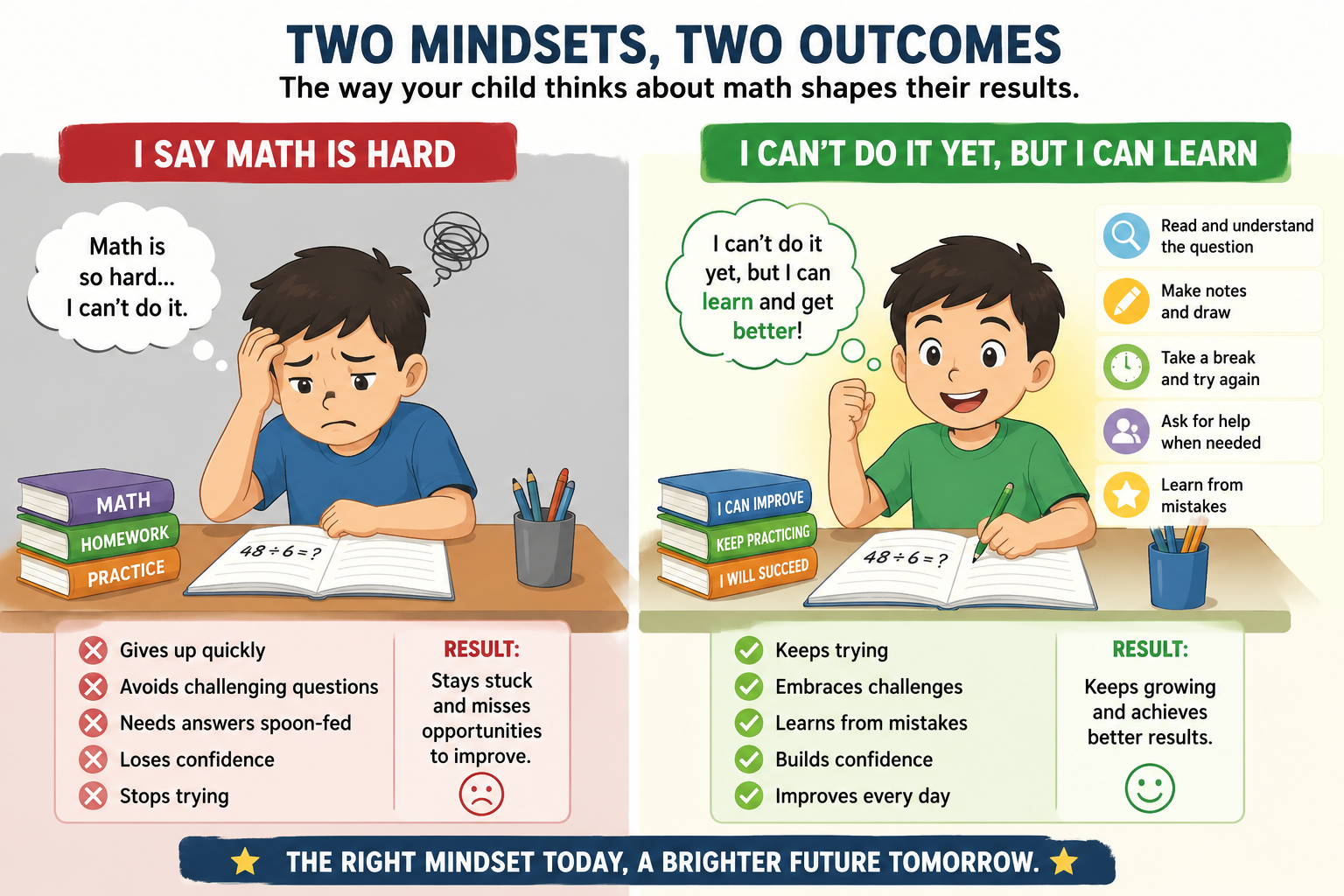
Unfortunately, when children repeatedly tell themselves that a question is "too hard," they may begin to avoid challenges altogether.
Some common reactions include:
* Giving up quickly
* Waiting for answers to be provided
* Copying solutions without understanding them
* Avoiding math practice
* Losing confidence in their ability to learn
Over time, these habits can create a self-fulfilling cycle of poor performance and low confidence.
What Should Children Say Instead?
Instead of saying:
"I can't do this."
Teach your child to say:
"I can't do this yet, but I can learn."
This simple word — yet — can make a powerful difference.
It shifts the focus away from ability and towards improvement.
Children do not need to pretend they understand something when they do not. In fact, recognising that they need help is an important first step in learning.
The key is helping them believe that improvement is possible.
Positive Actions Children Can Take When They Get Stuck
When children encounter a challenging math question, encourage them to take action instead of giving up.
Here are some useful strategies:
1. Read the Question Again
Many mistakes happen because children misunderstand what the question is asking.
Encourage them to slow down and identify:
* What information is given?
* What is being asked?
* Which numbers are important?
2. Annotate the Problem
Drawing models, highlighting key information, and making notes can help children organise their thinking and understand the problem more clearly.
3. Give Themselves Permission to Make Mistakes
Many children are afraid of getting the wrong answer.
However, mistakes are often the fastest way to learn.
A child who is willing to attempt a solution will usually learn more than a child who refuses to start.
4. Take a Short Break and Return Later
Sometimes stepping away from a problem allows the brain to process information in the background.
When children return later, they often see the question differently.
5. Seek Help
Learning does not have to be a solo journey.
Teachers, parents, and tutors can provide guidance that helps children overcome learning obstacles more efficiently.
Why Growth Mindset Matters in Mathematics
Children who develop a growth mindset understand that mathematical ability is not fixed.
They believe that:
* Skills can be improved through practice.
* Mistakes are opportunities to learn.
* Effort leads to progress.
* Difficulties can be overcome.
This mindset is especially important in PSLE Mathematics, where students are expected to tackle unfamiliar and challenging problem-solving questions.
Students who persist often outperform students who give up, even when they initially find the questions difficult.
What Parents Can Do at Home
The next time your child says:
"Math is hard."
Try responding with:
"Which part is challenging? Let's figure it out together."
Or when your child says:
"This is easy."
You can say:
"That's great. What strategy helped you solve it?"
These responses encourage children to focus on learning and problem-solving rather than simply judging the difficulty of a task.
Final Thoughts
The goal is not to convince children that everything is easy.
The goal is to help them believe that challenges can be overcome.
Instead of saying:
"It's hard."
Teach your child to say:
"I can't do it yet, but I'm learning."
That small shift in language can help build confidence, resilience, and a lifelong love of learning.
At AL1 Project Centre, we help students develop both strong mathematical concepts and the confidence to tackle challenging problems. Through our unique AL1 Formula — Concept Mastery + Peak Performance — students learn not only what to do, but also how to think when faced with difficult questions.
Because success in mathematics is not about avoiding challenges. It is about learning how to overcome them.
Want to help your child build confidence and improve in Mathematics?
Book a complimentary assessment with us.
📱 WhatsApp: 8145 9394
🌐 Learn more about our programmes and coaching services today.