Should Children Count on Their Fingers in Math? What Every Parent Needs to Know
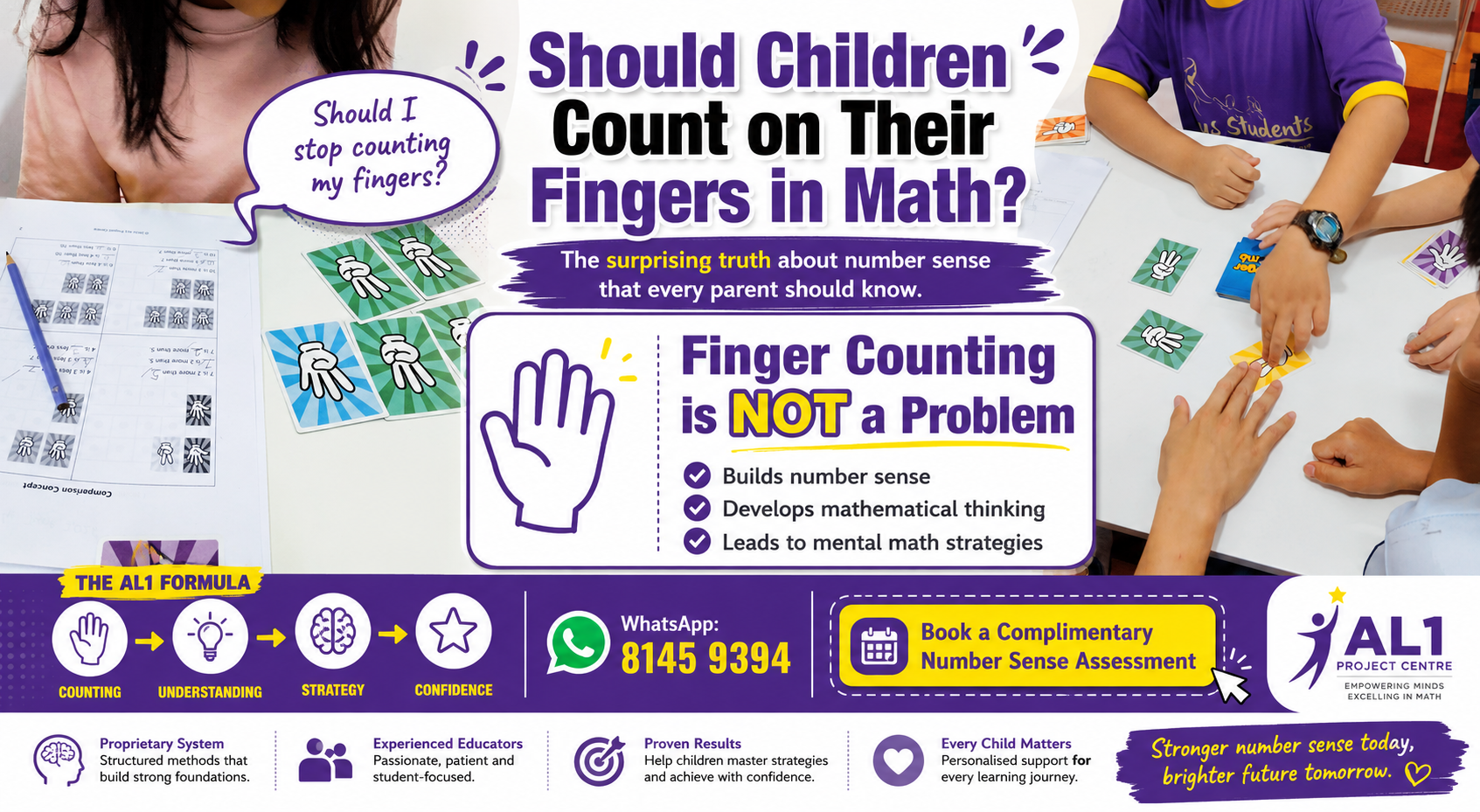
Should children count on their fingers when learning math? Discover why finger counting is a natural part of developing number sense and how it helps children build stronger mental math strategies.
One of the most common questions parents ask is:
"Should I stop my child from counting on their fingers?"
Many parents worry that finger counting is a bad habit. Some have even been told that children who count on their fingers are weak in mathematics.
The truth may surprise you.
The Short Answer: Yes, Let Them Count!
When young children learn addition and subtraction, finger counting is a perfectly natural and important part of their mathematical development.
In fact, almost every child goes through this stage.
Finger counting helps children develop an understanding of:
Quantity
Number relationships
Addition and subtraction
Counting sequences
Mental visualization of numbers
Rather than being a weakness, finger counting is often the first step towards strong number sense.
Why Some Children Stop Counting Earlier
You may notice that some children quickly move beyond finger counting.
For example, when solving:
9 + 4 = ?
Some children no longer need to physically count their fingers. They seem to know the answer almost instantly.
This does not mean they never used finger counting.
Instead, they have become so familiar with number patterns that they have developed more advanced strategies.
Their strong number sense was built on earlier counting experiences.
In other words:
Children who stop counting fingers successfully are usually children who counted fingers very well in the first place.
How Parents Can Help Children Progress
If your child is still counting fingers, resist the temptation to stop them.
Instead, use their current strategy as a bridge to more advanced thinking.
Let's look at the example:
9 + 4
Many children count:
9, 10, 11, 12, 13
using four fingers.
At this point, you can ask:
"When you reach 10, how many fingers are left?"
Your child may answer:
"Three."
Then ask:
"What is 10 and 3?"
The child can immediately see that:
10 + 3 = 13
Without realising it, they have begun using the powerful Make-10 Strategy, one of the most important mental math skills in primary school.
Beyond Fingers: Other Helpful Counting Tools
Finger counting is only one of many visual tools children can use.
Parents can also introduce:
Ten Frames
Ten frames help children visualize numbers and understand number bonds.
Number Lines
Number lines help children see addition and subtraction as movement along a sequence.
Manipulatives
Objects such as counters, cubes, beads, or cards help children build concrete understanding before moving to abstract concepts.
These tools support the development of flexible thinking and stronger number sense.
When Should Parents Be Concerned?
Finger counting itself is not a problem.
The real concern arises when an older child still relies exclusively on finger counting and has not developed more efficient strategies.
For example, by Primary 3 or Primary 4, children should gradually be able to:
Use number bonds automatically
Make tens mentally
Recognize number patterns
Recall basic facts efficiently
Use mental calculation strategies
If these skills are missing, it may indicate that:
The child was not developmentally ready when certain strategies were taught.
The child memorized answers without understanding concepts.
There are gaps in foundational number sense.
In such cases, the solution is not more drilling.
The solution is rebuilding conceptual understanding and helping the child develop flexible number strategies.
The AL1 Approach to Number Sense
At AL1 Project Centre, we believe that strong mathematics begins with strong number sense.
Rather than focusing on memorisation alone, we help children understand how numbers work through carefully designed activities, visual models, games, and structured thinking routines.
Our goal is to help every child progress from:
Counting → Understanding → Strategy → Confidence
When children truly understand numbers, mathematics becomes easier, more meaningful, and far more enjoyable.
Complimentary Number Sense Assessment
If your child is still struggling with basic calculations or relies heavily on finger counting, we would be happy to help.
📱 WhatsApp 8145 9394
Book a complimentary consultation and discover how your child can upgrade their number skills and build a stronger foundation for future mathematical success.