PSLE Preparation: The Best Gift You Can Give Your Child Is Confidence, Not More Pressure
How we respond to stress can have a greater impact than the stress itself. Read on to find ways to help your child manage PSLE stress.
PSLE Preparation: The Best Gift You Can Give Your Child Is Confidence, Not More Pressure
As PSLE draws closer, we speak with many parents who are feeling increasingly anxious about their child's preparation.
That feeling is completely understandable. Every parent wants the best for their child.
However, one important question is often overlooked:
How we respond to stress can have a greater impact than the stress itself.
Your child is probably already feeling the pressure of examinations, revision, homework and expectations. As parents and educators, our role is not to add to that pressure but to help them manage it effectively so they can perform at their best.
Mistakes Are Not the Problem
Many parents become worried when they see their child:
* Making careless mistakes repeatedly.
* Struggling with certain question types.
* Unable to complete assigned work.
* Losing motivation to study.
* Falling short of their target scores.
* Feeling discouraged after practice papers.
The list can seem endless.
But here's an important truth:
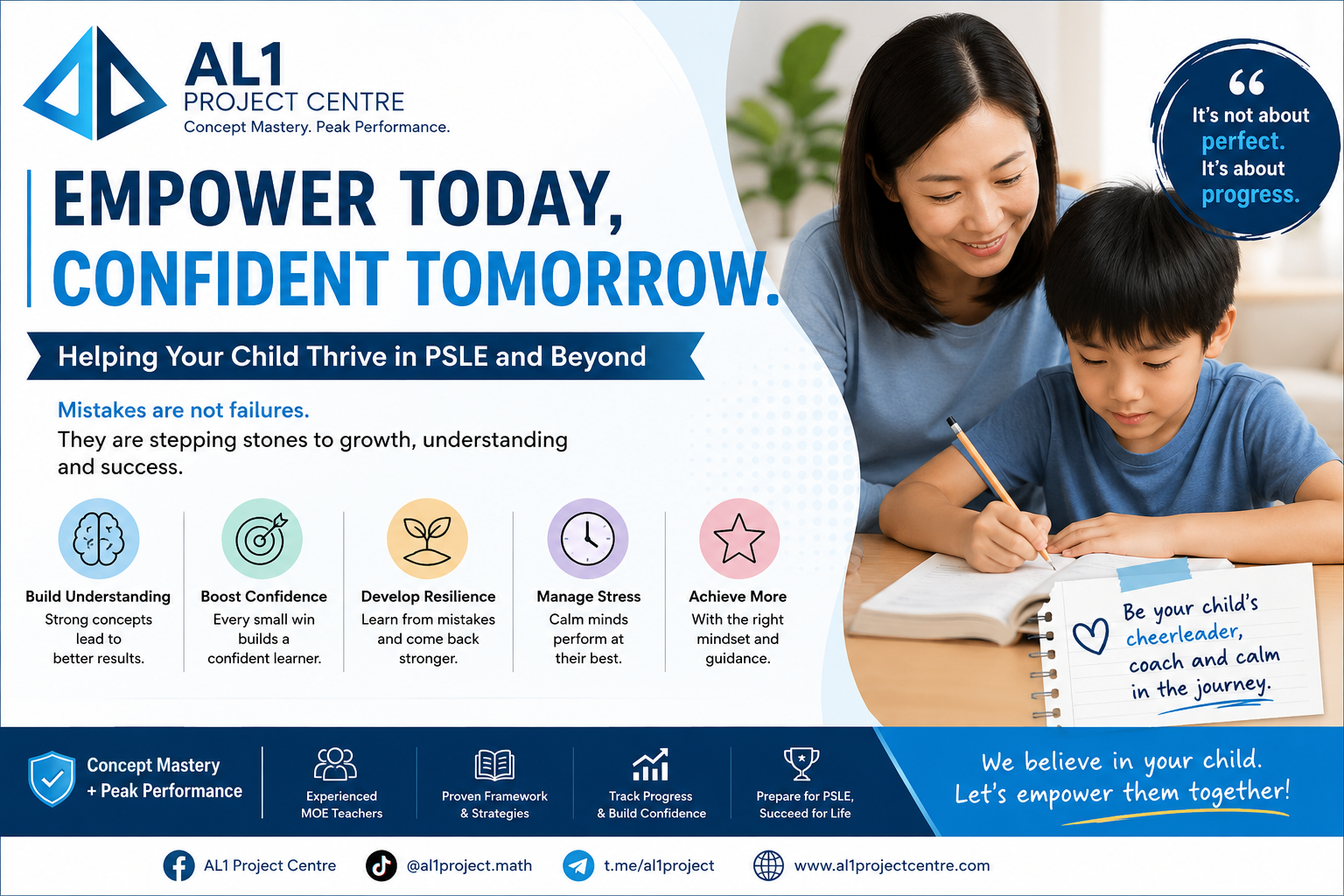
Mistakes are a natural and necessary part of learning.
Every mistake reveals something valuable. It tells us what the child has already understood and what still needs attention.
Instead of viewing mistakes as failure, we should see them as opportunities for growth.
Don't Just Correct Mistakes—Use Them to Empower
Of course, we are not suggesting that children should continue making the same mistakes without improvement.
Instead, ask yourself:
"How can I use this mistake to help my child become stronger?"
This small shift in mindset changes everything.
When children feel criticised, they often lose confidence.
When children feel empowered, they become more willing to learn, improve and persevere.
A Real Example
One of our students had fallen behind in her revision schedule and had not completed the work assigned.
Instead of asking,
"Why didn't you finish your work?"
we acknowledged something she was already experiencing.
We explained that preparing for the PSLE is challenging because students have to manage multiple subjects at the same time. Learning to prioritise tasks and manage time is itself an important life skill.
Rather than feeling guilty, the student felt understood.
She became more motivated to take ownership of her learning.
Her parent later shared that this change in approach made a noticeable difference in her attitude towards revision.
Empowerment Reduces Stress
Whenever you notice stress increasing—whether in yourself or your child—pause and ask:
* Is there another way to explain this concept?
* Can we break today's work into smaller goals?
* Would a short break help improve focus?
* How can I encourage rather than criticise?
Sometimes changing our approach is far more effective than increasing the amount of work.
The Goal Is More Than Good Grades
PSLE is important, but it is also an opportunity to build resilience, confidence and independence.
Children who learn to overcome challenges develop skills that will benefit them far beyond the examination.
Instead of asking,
"Why are you making so many mistakes?"
try asking,
"What can we learn from this mistake?"
That simple change can transform stress into confidence and frustration into growth.
At AL1 Project Centre, we believe that every child can improve when they understand concepts deeply, develop confidence, and receive the right guidance.
Because PSLE preparation should not just be about achieving better grades.
It should be a journey of empowerment.