My Child Is Failing Math Despite Tuition: Why the Right Diagnosis Matters
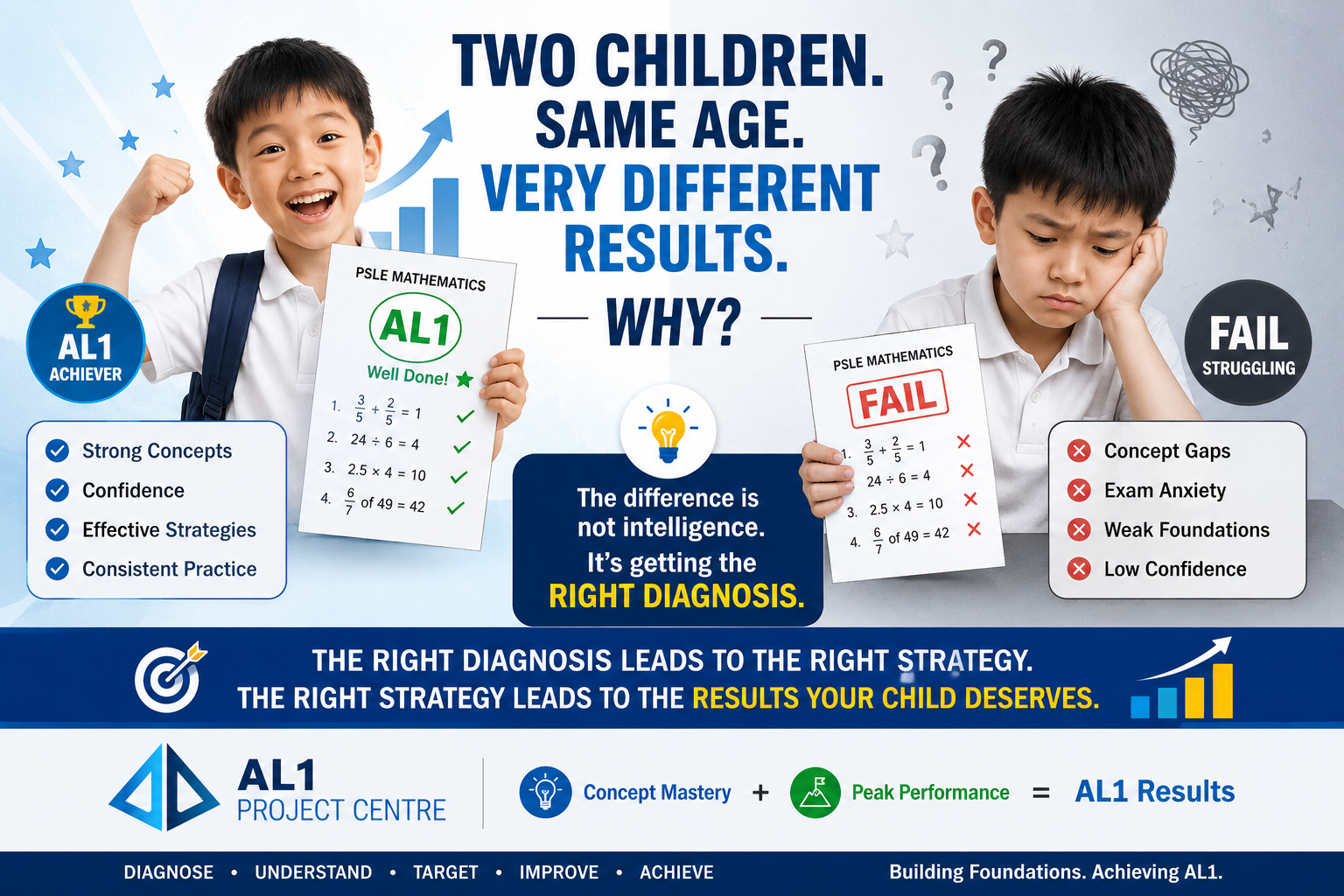
The difference between an AL1 student and a failing student is often not intelligence, but understanding the root cause of the problem. Read on to find out why the right diagnosis matters.
Is PSLE Math Really That Hard?
Many parents ask:
"Why are PSLE Math questions so difficult nowadays?"
The Ministry of Education (MOE) has addressed this concern. According to MOE, most questions in the PSLE Mathematics paper are designed to be accessible to students who have mastered the syllabus. Only a small proportion of questions—about 15% of the paper—are intended to differentiate students who demonstrate higher levels of mathematical thinking.
In fact, MOE data shows that nearly half of all PSLE students score 75 marks or higher (AL4 or better) for Mathematics.
This raises an important question:
If so many students can achieve AL4 and above, why is my child struggling?
The Real Question Parents Should Ask
When parents see disappointing results, the natural reaction is often:
* Enrol in more tuition classes
* Buy more assessment books
* Increase practice papers
* Spend more hours studying
While these strategies may help some children, they do not address the most important issue:
What is the real reason behind the child's underperformance?
Without identifying the root cause, even the best tuition programme may fail to produce meaningful improvement.
A Medical Analogy Every Parent Can Understand
Imagine your child falls sick.
Would you visit the doctor on your child's behalf and ask for medicine without the doctor examining your child?
Of course not.
A responsible doctor first:
1. Assesses the symptoms
2. Identifies the underlying problem
3. Makes a diagnosis
4. Prescribes the appropriate treatment
The same principle applies to Mathematics learning.
Before deciding on the solution, we must first understand the problem.
Not All Math Struggles Are the Same
Two children may both score 50 marks for Mathematics.
However, their underlying issues could be completely different.
Child A: Conceptual Gaps
This child struggles with:
* Fractions
* Ratios
* Percentages
* Model Method
No matter how many questions are attempted, weak conceptual understanding limits progress.
Child B: Exam Performance Issues
This child understands the concepts but:
* Rushes through questions
* Misreads information
* Experiences exam anxiety
* Loses concentration during long papers
The issue is not mathematical ability but exam performance.
Child C: Weak Foundations
This child still struggles with:
* Multiplication tables
* Number sense
* Mental calculations
* Basic arithmetic fluency
As topics become more advanced, these weak foundations create bigger learning gaps.
Child D: Low Confidence
This child has developed the belief that:
"I'm just not good at Math."
As confidence drops, motivation drops as well. The child becomes reluctant to attempt challenging questions and stops learning effectively.
Each child requires a different intervention.
A one-size-fits-all solution rarely works.
Why More Tuition Is Not Always the Answer
Many parents tell us:
"My child has been attending tuition for years but the results have not improved."
In such situations, adding another tuition class may not solve the problem.
Instead, parents should ask:
* What exactly is preventing my child from improving?
* What are my child's biggest learning gaps?
* Is the issue conceptual, emotional, behavioural, or strategic?
* What specific support does my child need?
Without clear answers, parents may spend significant time and money without seeing meaningful progress.
The Importance of a Proper Diagnosis
A proper diagnosis helps to identify:
* Strengths and weaknesses
* Conceptual gaps
* Study habits
* Exam techniques
* Confidence levels
* Learning behaviours
Once the root causes are identified, a targeted improvement plan can be developed.
This makes learning more effective and often leads to faster progress.
Can a Child Improve from AL5 or AL6 to AL4?
Absolutely.
Many children are capable of achieving significantly better results once the right issues are identified and addressed.
Improvement is rarely about intelligence.
More often, it is about:
* Understanding the child's learning profile
* Addressing the right problem
* Using the right strategy
* Building confidence through small successes
Final Thoughts
When a child is underperforming in Mathematics, the goal should not be to find more worksheets or more tuition immediately.
The first step is to understand why the child is struggling.
Just as doctors diagnose before prescribing treatment, educators should diagnose before recommending solutions.
The right diagnosis leads to the right strategy.
And the right strategy gives every child the opportunity to achieve the results they deserve.
Need Help Identifying What's Holding Your Child Back?
At AL1 Project Centre, we believe that every child can improve when the root causes of their difficulties are identified and addressed.
Our diagnostic assessment and coaching approach help parents understand their child's learning profile, uncover hidden obstacles, and develop a personalised action plan to improve Mathematics performance.
Because the right diagnosis is often the first step towards a breakthrough.