Math Today vs Math 20 Years Ago: Why Singapore Children Learn Mathematics Differently
Discover how mathematics education in Singapore has changed over the past 20 years, why Primary 1 and Primary 2 exams were removed, and how parents can help children build strong math foundations.
Is Math Today Different from the Math We Learned as Children?
Why Many Singapore Parents Are Surprised by Their Child's Math Performance
As parents, we often compare our children's learning experiences with our own.
When a child struggles with mathematics, a common question arises:
"Are children today different from children in the past?"
Perhaps a better question is:
"Is mathematics today different from the mathematics we learned 20 years ago?"
The answer is a definite yes.
How Has Mathematics Education Changed?
The world has changed dramatically over the past two decades.
Technology has transformed the way we work, communicate, and learn. Today's children have instant access to information through the internet, digital learning platforms, and even Artificial Intelligence (AI) tools that can solve mathematical problems within seconds.
As a result, mathematics education has evolved as well.
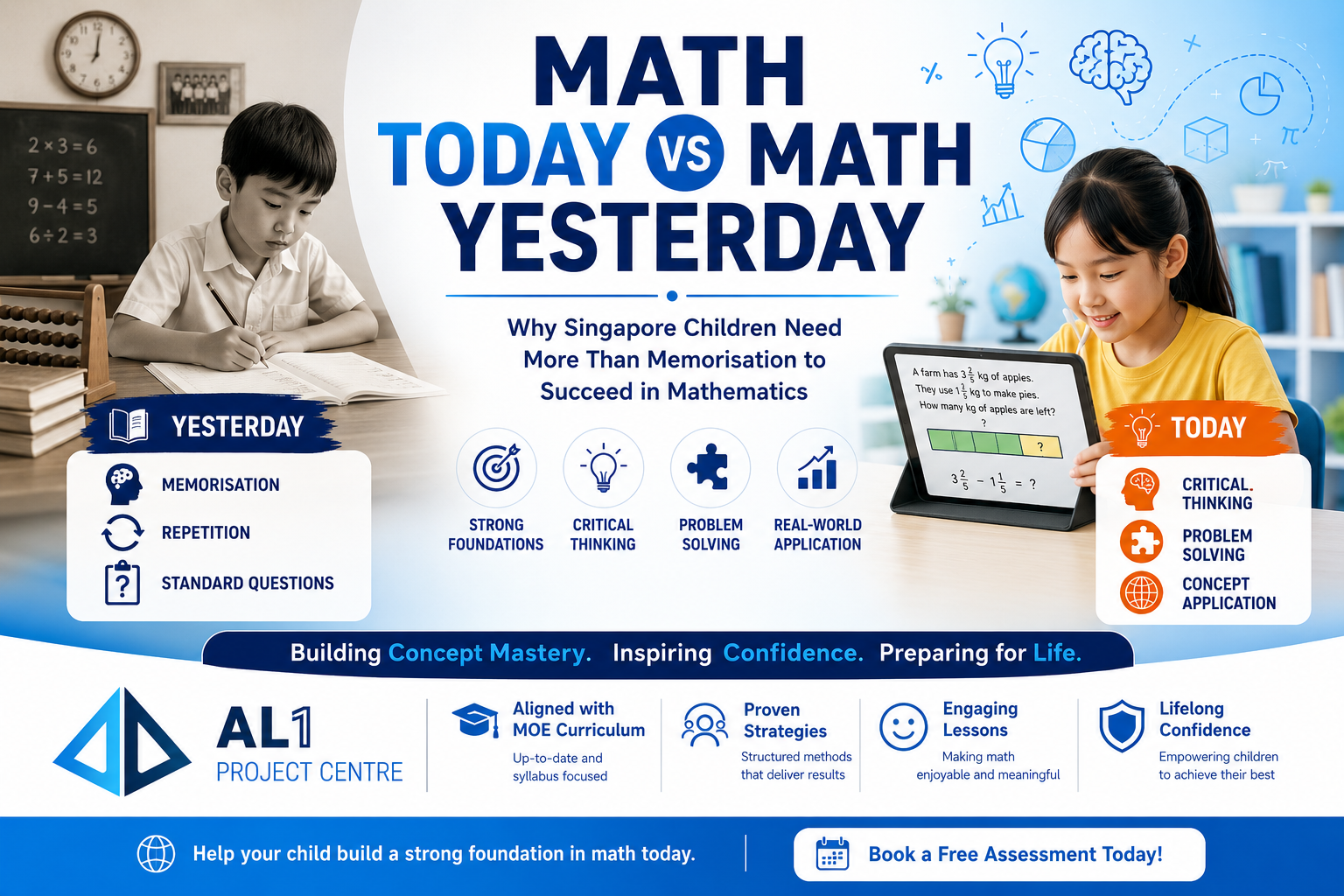
In the past, success in mathematics often depended heavily on memorisation and repetitive practice. Today, the emphasis is increasingly placed on:
Critical thinking
Problem-solving skills
Conceptual understanding
Real-world application of mathematics
Students are no longer expected to simply recall formulas and procedures. They must understand why concepts work and apply them to unfamiliar situations, especially in challenging word problems.
This shift explains why some parents find today's mathematics questions very different from what they encountered during their own school days.
Why Are There No Exams in Primary 1 and Primary 2?
Another major change in Singapore's education system is the removal of examinations for Primary 1 and Primary 2 students.
For many parents, this raises an important concern:
"How do I know whether my child is learning enough mathematics?"
The Ministry of Education (MOE) implemented this change for a good reason.
At the ages of seven and eight, children are still developing:
Cognitive skills
Emotional resilience
Learning habits
Attitudes towards school
By removing high-stakes examinations, young children can focus on building confidence and developing a positive relationship with learning rather than experiencing unnecessary academic stress.
This allows children to explore mathematics with curiosity instead of fear.
The Hidden Challenge Parents Often Discover in Primary 3
While reducing stress is beneficial, it also creates a challenge.
Without regular examinations, some parents may not have a clear picture of their child's level of mastery.
The reality often becomes apparent when children enter Primary 3.
At this level, students begin facing:
Weighted Assessments (WA)
End-of-Year examinations
More complex multiplication and division concepts
Multi-step word problems
Higher expectations in mathematical reasoning
For some families, Primary 3 becomes a rude awakening.
A child who appeared to be coping well in Primary 1 and Primary 2 may suddenly struggle when faced with the increased rigour of formal assessments.
The issue is usually not intelligence.
The issue is often a lack of mastery in foundational concepts that went unnoticed during the lower primary years.
Should We Bring Back Exams for Primary 1 and Primary 2?
Some parents believe that bringing back examinations would solve this problem.
However, the answer is no.
Examinations are not necessarily the best way to determine whether a child is learning effectively.
The additional stress placed on young children is often not worth the cost.
Instead, parents should focus on:
Monitoring conceptual understanding
Observing learning progress regularly
Identifying misconceptions early
Encouraging a positive attitude towards mathematics
Connecting mathematics to everyday life
When children understand mathematics deeply, they perform better naturally when assessments eventually arrive.
The Goal Is Not Less Stress or More Stress — It Is Better Learning
The real objective should not be to make mathematics harder or easier.
The goal should be to make mathematics meaningful, enjoyable, and understandable while ensuring that children develop genuine mastery of concepts.
Children learn best when they:
Understand what they are doing
Experience success regularly
Build confidence gradually
See relevance in what they learn
When these conditions are present, academic achievement often follows naturally.
How AL1 Project Centre Helps Children Master Mathematics
At AL1 Project Centre, we believe that mathematics should be both enjoyable and effective.
Through our proprietary 6-Step Concept Mastery Process, we help students:
✓ Build strong conceptual foundations
✓ Apply concepts confidently to word problems
✓ Develop critical thinking skills
✓ Close learning gaps early
✓ Prepare effectively for examinations without unnecessary stress
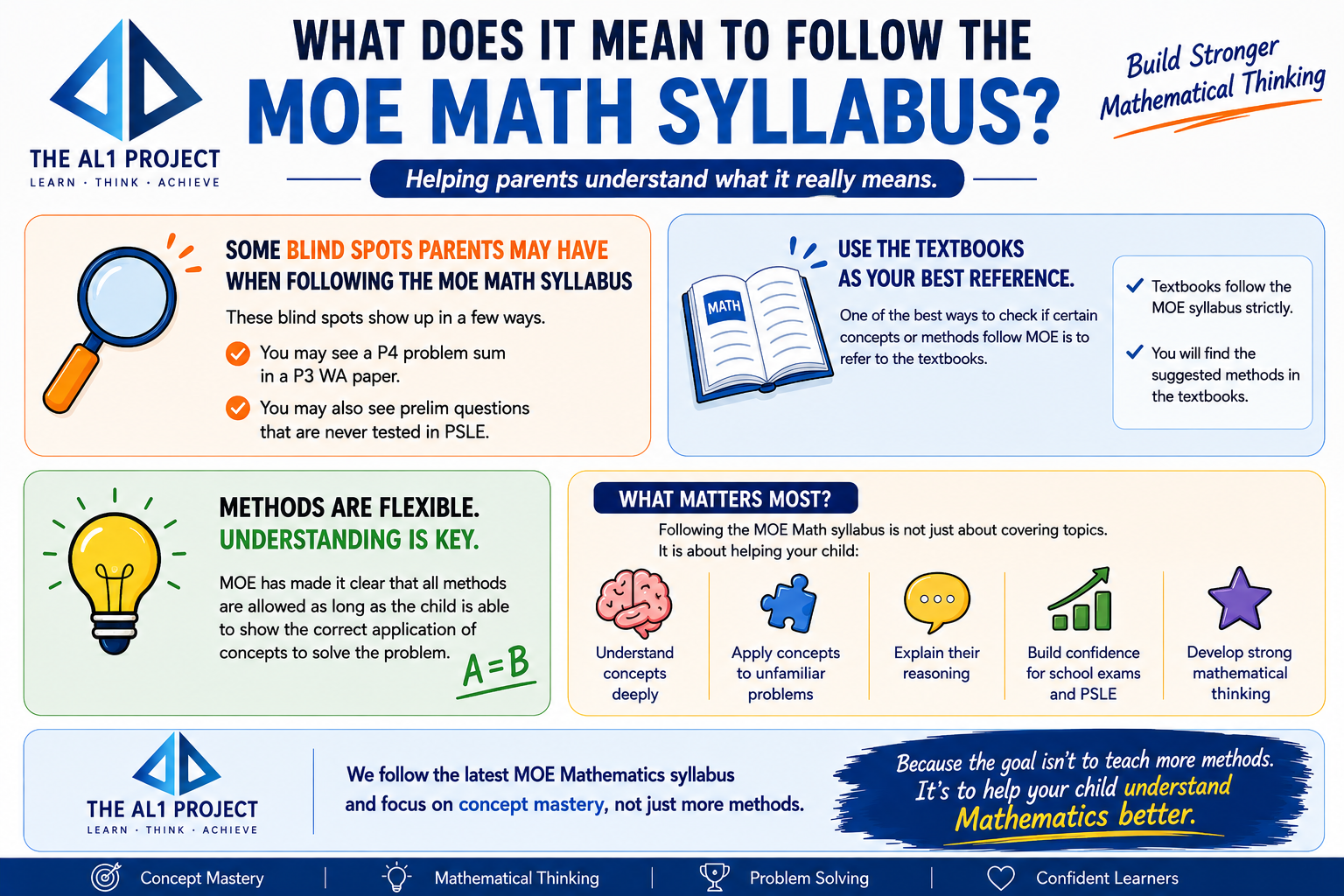
Our lessons and curriculum materials are carefully designed to align with the latest MOE mathematics syllabus while helping children develop a lifelong confidence in learning mathematics.
Because when children truly understand mathematics, success becomes a natural outcome.
Final Thoughts
The question is not whether children today are different from children in the past.
The more important question is whether our approach to mathematics learning has kept pace with the demands of today's world.
Mathematics education has changed. The skills children need have changed. The way we support them must change too.
By focusing on understanding rather than memorisation, and mastery rather than marks alone, we can help children become confident and capable mathematical thinkers.