Master Multiplication Tables in 30 Days: 4 Division Strategies That Make Math Easier for Children
Discover 4 powerful division strategies from Master Multiplication Tables in 30 Days. Help your child improve math fluency and confidence.
4 Powerful Division Strategies Every Child Should Know
*Struggling with division? The solution may be simpler than you think.*
For many children, division is the most challenging operation in mathematics. Every year, students learn addition first, followed by subtraction, multiplication, and finally division. By the time they reach division, many children begin to lose confidence because division appears more complex and less intuitive than the other operations.
One reason is that children spend years memorising multiplication tables, but there are no equivalent "division tables" to memorise. As a result, division often feels unfamiliar and difficult.
The good news is that strong division skills are built on strong multiplication skills.
In our newly released book, Master Multiplication Tables in 30 Days: The 5+5 Memory System™, we teach children how to use their multiplication knowledge to become more confident and accurate in division.
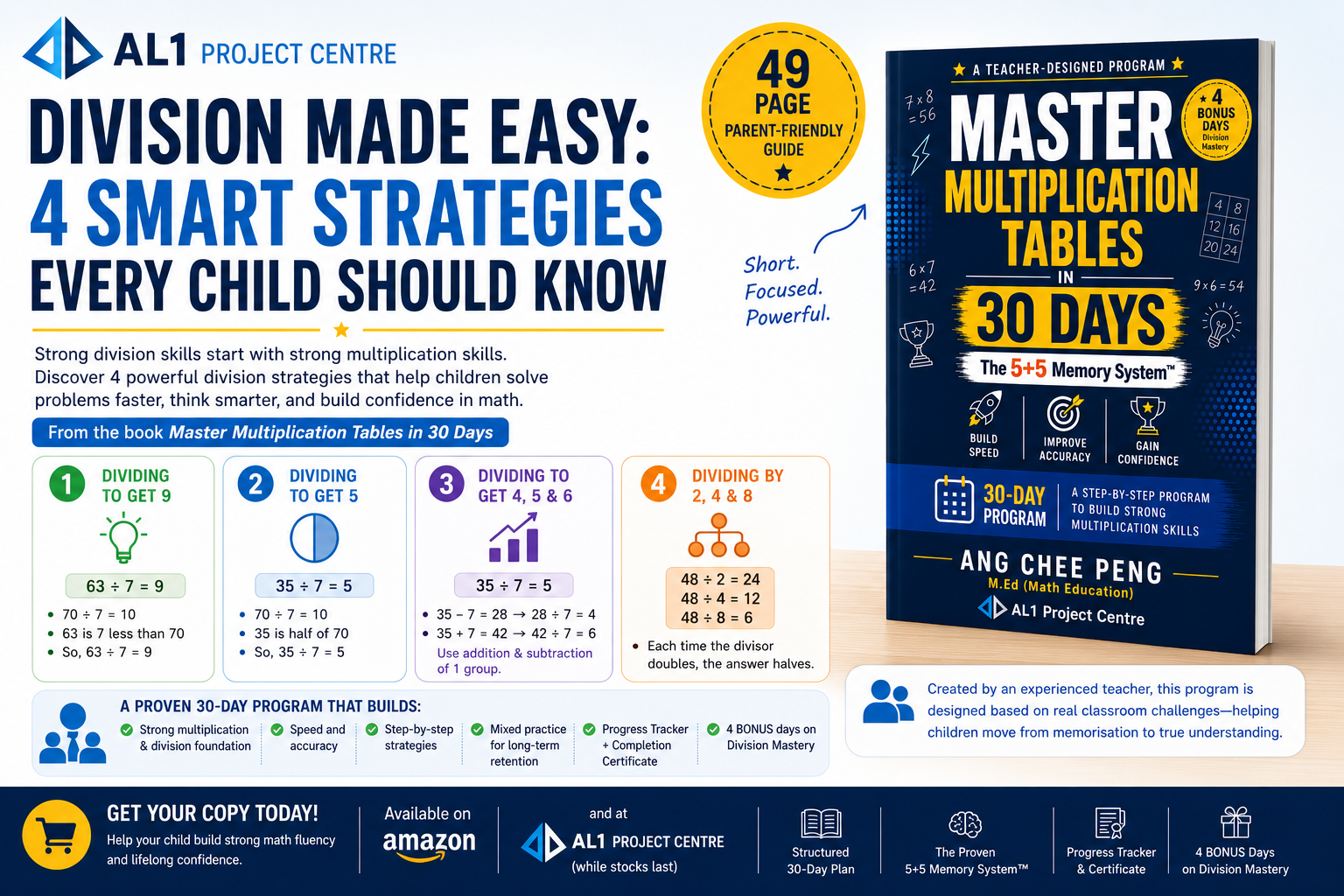
Here are four powerful division strategies featured in the book.
Strategy 1: Dividing to Get 9
63 ÷ 7 = ?
Most children will try to recall their multiplication facts. However, there is a faster way.
* 70 ÷ 7 = 10
* 63 is 7 less than 70
* Therefore, 63 ÷ 7 = 9
By understanding number relationships, children can solve division problems mentally and confidently.
Strategy 2: Dividing to Get 5
35 ÷ 7 = ?
Consider this:
* 70 ÷ 7 = 10
* 35 is half of 70
* Therefore, 35 ÷ 7 is half of 10
Answer: 5
This strategy helps children see patterns instead of relying purely on memorisation.
Strategy 3: Dividing to Get 4, 5 and 6
Once children know:
35 ÷ 7 = 5
they can quickly derive related facts:
* 35 − 7 = 28 → 28 ÷ 7 = 4
* 35 + 7 = 42 → 42 ÷ 7 = 6
Instead of memorising hundreds of facts, children learn how numbers are connected.
Strategy 4: Dividing by 2, 4 and 8
Consider these calculations:
* 48 ÷ 2 = 24
* 48 ÷ 4 = 12
* 48 ÷ 8 = 6
Notice something interesting?
Each time the divisor doubles, the quotient halves.
* Half of 24 is 12
* Half of 12 is 6
Recognising these patterns helps children develop strong mental math skills and solve problems more efficiently.
Why These Strategies Work
Many children struggle with division because they see it as a completely different topic from multiplication.
At AL1 Project Centre, we teach children to see the connection between the two operations. When multiplication facts are deeply understood, division becomes significantly easier.
This is the foundation of our 5+5 Memory System™, which helps children:
✓ Master multiplication tables faster
✓ Improve division accuracy
✓ Build mental math skills
✓ Gain confidence in problem solving
✓ Develop long-term mathematical understanding
About the Book
Master Multiplication Tables in 30 Days: The 5+5 Memory System™ is a teacher-designed programme created by Ang Chee Peng, M.Ed (Math Education).
Inside this 49-page guide, children will discover:
* A structured 30-day learning plan
* The proven 5+5 Memory System™
* Multiplication and division strategies
* Progress Tracker
* Completion Certificate
* 4 Bonus Days on Division Mastery
Whether your child is struggling with times tables or simply needs greater confidence in mathematics, this book provides a practical step-by-step pathway to success.
Get Your Copy Today
The book is available on Amazon and directly from AL1 Project Centre while stocks last.
Parents who want their children to build strong multiplication and division foundations can start here.
Master Multiplication Tables in 30 Days – because confidence in math begins with mastery of the basics.