Lessons from PSLE 2026: Motivation Matters
One lesson we can take from PSLE 2026 is that children can become highly motivated when they have a meaningful goal. The challenge is to help them develop that motivation before the pressure becomes intense. Start early.
Every year, something interesting happens as the PSLE draws nearer.
Children who previously needed reminders to revise suddenly become more serious. They start practising on their own, asking more questions and paying closer attention to their mistakes.
Why?
They are motivated.
The PSLE has become real to them. They have a clear goal, and they want to do well.
But as parents and teachers, an important question is:
Do we have to wait until the PSLE is just around the corner before our children become motivated to learn?
Motivation Matters More Than We May Realise
A 2026 longitudinal study following children from ages 8 to 16 found an important relationship between intrinsic motivation and mathematics achievement.
Children who became more intrinsically motivated tended to show improvements in mathematics achievement later—and improved achievement, in turn, predicted greater motivation.
In other words, success can build motivation, and motivation can help build further success.
This is especially relevant to PSLE preparation.
Instead of relying on pressure as the examination approaches, we should try to build a positive cycle much earlier:
Motivation → Effort → Improvement → Confidence → More Motivation
So how can parents help?
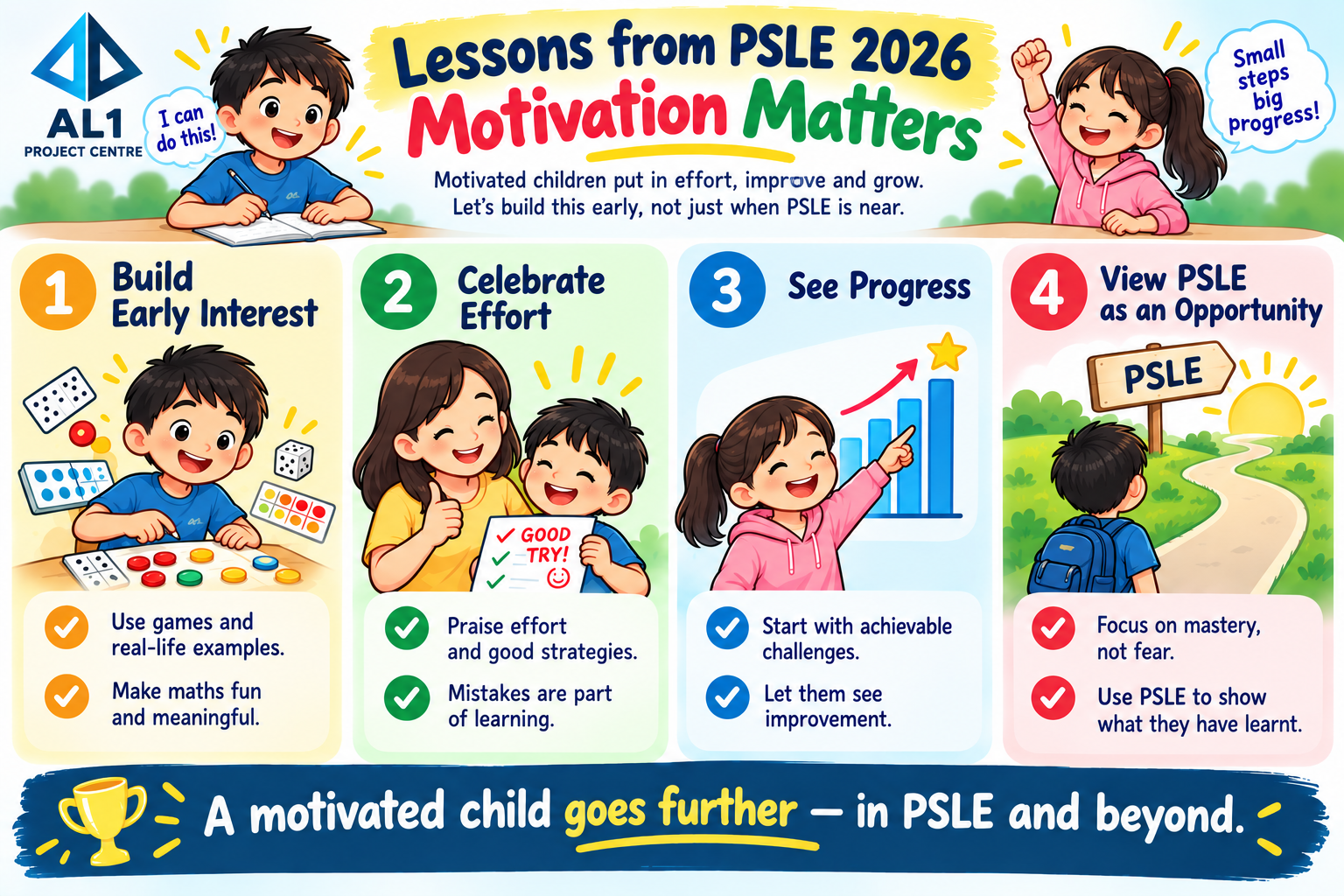
1. Help Your Child Experience Success
Children are more likely to put effort into something when they believe they can succeed.
If every mathematics practice feels overwhelmingly difficult, motivation will quickly disappear.
During PSLE preparation, give your child opportunities to experience small wins. Start with questions they can manage before gradually increasing the challenge.
Let them see their progress.
A child who thinks, “I am getting better at this,” is much more likely to keep going than one who thinks, “I am just bad at maths.”
2. Make Mathematics More Than Assessment Books
If mathematics is always associated with worksheets, corrections and marks, it is difficult for children to develop a genuine interest in it.
Especially when children are younger, mathematics should also involve games, puzzles, investigations and everyday situations.
Ask them to estimate a restaurant bill. Compare discounts while shopping. Play number games. Look for patterns. Challenge them with interesting problems.
Help them discover that mathematics is not simply a subject to be tested at PSLE.
Mathematics is something they can think about, explore and enjoy.
3. Praise Effort, Strategy and Improvement
During PSLE preparation, children will make mistakes.
That is not necessarily a bad thing.
A mistake can show us exactly what needs to be improved.
Instead of focusing only on the score, recognise the process:
“You didn't get this question right, but your method was much better this time.”
“You found your mistake yourself. That's progress.”
“This type of question used to be difficult for you. Look at what you can do now.”
The message we want children to receive is:
“I can improve if I keep learning.”
4. Turn PSLE Preparation Into Mastery, Not Fear
PSLE is important, but fear should not be the main reason a child studies.
Instead of repeatedly reminding children how much is at stake, help them see the examination as an opportunity to demonstrate what they have learnt.
The goal of preparation should gradually shift from:
“I must study because PSLE is coming.”
to:
“I want to see how much I can improve.”
That small change in perspective can make a big difference.
Don't Wait Until PSLE Is Near
One lesson we can take from PSLE 2026 is that children can become highly motivated when they have a meaningful goal.
The challenge is to help them develop that motivation before the pressure becomes intense.
Start early.
Give them achievable challenges. Let them experience success. Celebrate improvement. Make mistakes safe. Help them enjoy mathematical thinking.
Because ultimately, successful PSLE preparation is not simply about getting children to practise more questions.
It is about helping them become children who want to improve.
And when a child genuinely wants to improve, preparation becomes much more powerful.