How to Teach Primary 1 Math in Term 3: The Foundation for Future Success
The best way to support your child is not through endless drilling or memorising procedures. Instead, help them understand the concepts behind the mathematics.
How to Teach Primary 1 Math in Term 3: The Foundation for Future Success
Many parents think that Primary 1 Math is relatively easy. However, Term 3 is one of the most important periods in your child's mathematical journey. It is during this term that children build the number sense and thinking skills that will support them throughout Primary School.
A strong understanding of these concepts gives children confidence and prepares them for more challenging topics in Primary 2 and beyond. On the other hand, weak foundations often lead to struggles with problem-solving, mental calculation, and even confidence in mathematics.
The Most Important Concept: Tens and Ones
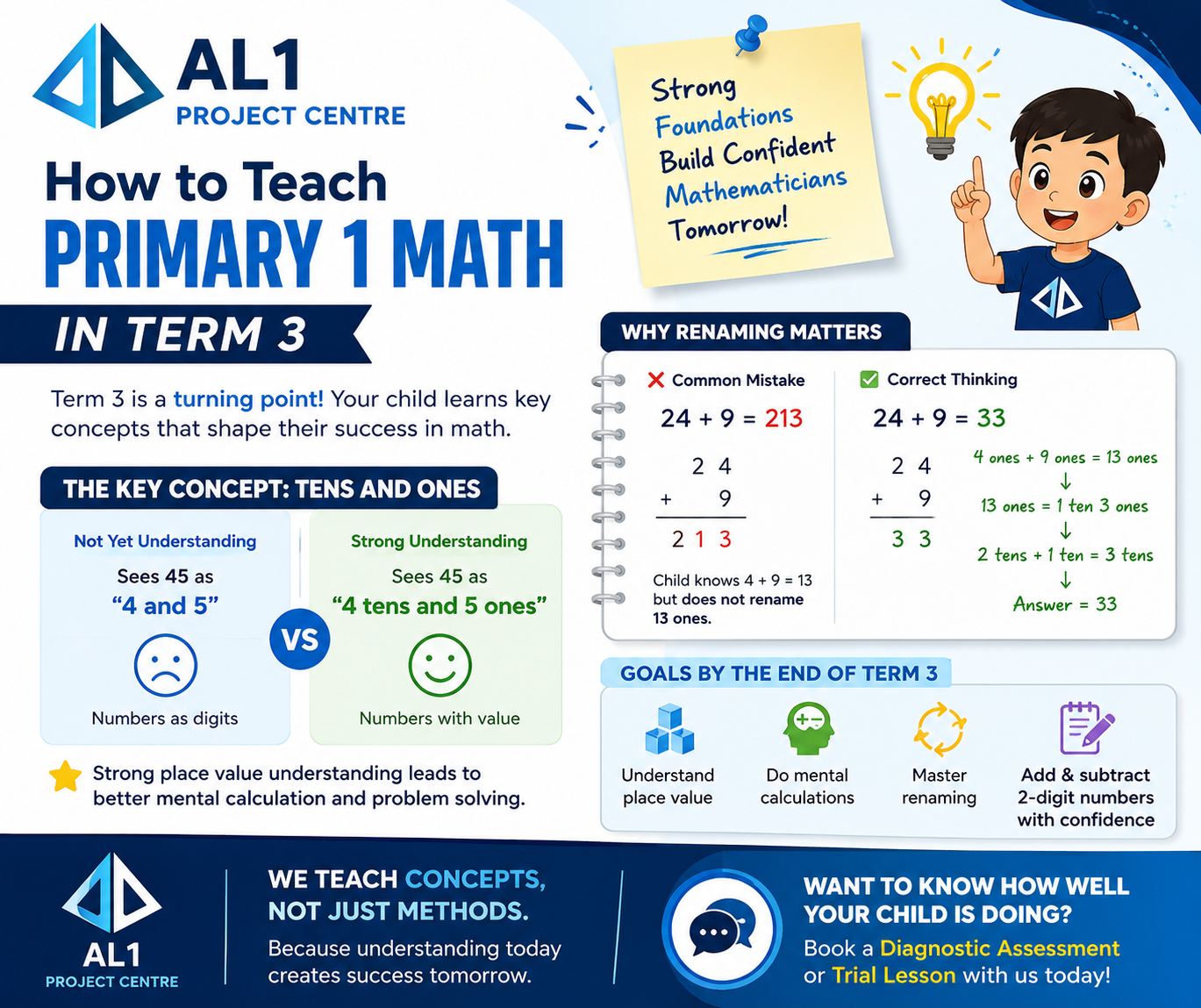
One of the biggest milestones in Primary 1 Term 3 is understanding tens and ones.
Ask yourself this question:
When your child sees the number 45, do they see it as simply the digits "4" and "5", or do they immediately recognise it as 4 tens and 5 ones?
This may seem like a small difference, but it has a huge impact on mathematical thinking.
Many children treat numbers as a string of individual digits rather than understanding the value of each digit. Without a strong understanding of place value, mental calculation becomes much more difficult.
For example, a child who understands tens and ones can quickly work out:
* 45 + 30 = 75
* 68 - 20 = 48
Instead of counting one by one, they can think in groups of tens, making calculations faster and more accurate.
Why Some Children Struggle with Column Addition
A weak understanding of place value often leads to difficulties with renaming (also known as regrouping or carrying).
For example, some children may incorrectly calculate:
24 + 9 = 213
This mistake happens because they know that 4 + 9 = 13, but they do not understand that 13 ones must be renamed as 1 ten and 3 ones.
Instead of thinking about place value, they simply write "13" in the ones column.
Children who truly understand tens and ones think differently:
* 4 ones + 9 ones = 13 ones
* 13 ones = 1 ten and 3 ones
* 2 tens + 1 ten = 3 tens
* Final answer = 33
This understanding is what allows children to perform addition accurately and confidently.
Building on the "Make-Ten" Strategy
In Term 2, children learn the Make-Ten Strategy to simplify addition.
For example:
9 + 4 = 13
In Term 3, they take the next important step.
Instead of stopping at 13, they learn that:
13 ones = 1 ten and 3 ones
This new understanding connects mental strategies with place value, laying the foundation for column addition, subtraction with renaming, multiplication, and division in later years.
The Goal of Primary 1 Term 3
By the end of Term 3, your child should be able to:
* Understand place value confidently.
* Recognise numbers as tens and ones.
* Rename numbers accurately.
* Perform mental calculations efficiently.
* Solve two-digit addition and subtraction with confidence.
These are not just Primary 1 skills—they are essential building blocks for future success in mathematics.
How Parents Can Help
The best way to support your child is not through endless drilling or memorising procedures.
Instead, help them understand the concepts behind the mathematics.
When children truly understand why numbers work the way they do, they become more confident, make fewer careless mistakes, and enjoy learning mathematics much more.
At AL1 Project Centre, we believe that strong mathematical understanding always comes before memorising methods. By building concepts first, children develop the confidence and thinking skills needed to succeed throughout primary school and beyond.
Strong foundations today create confident mathematicians tomorrow.