Does Being Weak in Math Mean My Child Has Dyslexia? A Guide for Parents
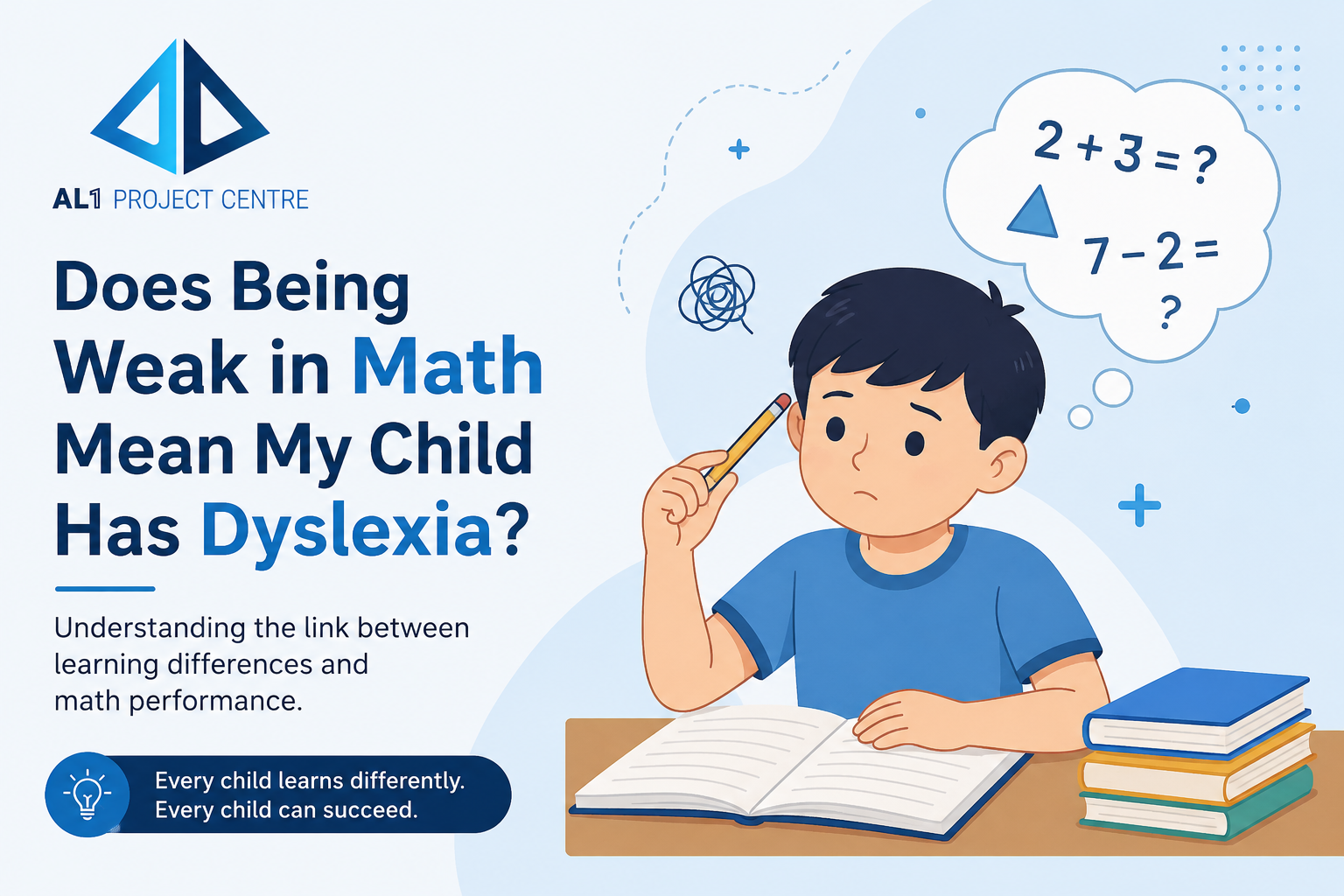
Many parents worry that poor Math results may indicate dyslexia. The truth is more nuanced. Learn what dyslexia really is and how it affects Math learning.
One question we occasionally hear from concerned parents is:
"My child is struggling with Math. Does that mean he or she has a learning disorder such as dyslexia?"
The short answer is: not necessarily.
Whenever parents raise this concern, our first question is usually:
"Has your child received a formal diagnosis from a qualified professional?"
It is important to understand that learning disorders such as dyslexia or dyscalculia can only be diagnosed by trained specialists. Neither parents, teachers, nor tutors are in a position to make such a diagnosis based solely on a child's academic performance.
Dyslexia Does Not Automatically Mean Poor Math Performance
Over the years, we have worked with students who have been diagnosed with dyslexia or dyscalculia. One common misconception we would like to address is that having a learning disorder automatically means a child will struggle with mathematics.
In reality, this is not always true.
Many students with dyslexia perform very well in Math. Some are able to grasp mathematical concepts quickly and demonstrate strong problem-solving abilities despite facing challenges in other areas of learning.
This is because dyslexia primarily affects the way a person processes language-based information, rather than their mathematical reasoning ability.
How Dyslexia Can Affect Math Learning
A child with dyslexia may understand mathematical concepts well but face difficulties in areas such as:
* Reading lengthy word problems accurately
* Remembering specific details or instructions
* Processing large amounts of written information
* Skipping words, numbers, or key information while reading
* Following multi-step written procedures
As a result, a child may appear to struggle with Math even when the underlying mathematical concepts are understood.
This is why it is important not to jump to conclusions based solely on test results or school grades.
Effective Teaching Makes a Difference
When teaching children with dyslexia, one of the most important principles is to present information in a way that connects with what they already know.
Concepts should be broken down into manageable steps, supported with visual representations, and reinforced through meaningful practice. The goal is not simply to teach procedures but to help students build deep understanding and confidence.
At AL1 Project Centre, we believe that effective learning happens when teaching is adapted to the needs of the child. Whether a student has a diagnosed learning difficulty or simply requires additional support, the focus should always be on helping the child understand concepts clearly and apply them confidently.
The Most Important Takeaway
Labels do not define a child's potential.
A child who struggles with Math does not automatically have dyslexia. Likewise, a child with dyslexia is fully capable of succeeding in Mathematics.
Rather than focusing on labels, parents should focus on obtaining an accurate diagnosis when necessary and ensuring that their child receives high-quality, child-centred instruction based on sound educational practices.
Every child can learn. The key is understanding how they learn best and providing the right support at the right time.
Concerned About Your Child's Math Performance?
If your child is struggling with Math, the first step is to identify the root cause of the difficulty. Is it a conceptual gap? A problem-solving issue? A reading challenge? Or simply a lack of confidence?
At AL1 Project Centre, we help parents diagnose learning gaps and develop a personalised plan to help children build strong mathematical foundations and achieve their full potential.